


.svg)

.svg)


ATD 2026 Takeaways: AI Got Quiet. Content Ops Got Loud.



The floor was quieter than the marketing
AI and the phrase "AI platform" at booths were quite common this year at ATD 2026, but unlike last year, very few were asking the generic question, "What AI do you have?".
If that gap matches what you've been seeing in your own L&D work, you weren't imagining it.
You could walk the Los Angeles Convention Center for four full days, and the buzz of AI was clear. But this year, attendees were more informed.
Many had already experienced AI on multiple levels. That was leading them to more specific questions, into areas like how to manage all this AI-driven content.
With more (and sometimes easier to produce) content, the successive problems became how to manage that content and updates effectively. Even more so: how is content production and AI usage governed so that content quality can be preserved and continually improved?
In short, how do you keep from generating an unwieldy mess and avoid the trend toward AI slop?
This and other specific use cases were the types of conversations our team at the dominKnow booth continued to hear.
Practitioners weren't shopping for AI generically. They were looking for specific capabilities and how to better manage quality and growth in the AI-assisted and generated content.
Not quite as sexy as some of the topics covered by keynotes, but it is the practical reality many teams are now facing.
AI became table stakes, and the floor showed it
For two years, "we have AI" was a differentiator.
At ATD 2026 it's well on its way to commonplace. Teams have started to use AI in various capacities and are beginning to focus again on what moves the needle for them.
Christopher Goodsell captured it cleanly: "AI is no longer the L&D conversation. It's the infrastructure."
Many LMS vendors led with "AI-enabled platform" messaging, focused on what AI did rather than how their systems actually improved learning outcomes. Yet practitioner questions had started to shift toward data, governance, integration, and outcomes.
Who was actually walking the floor
The pattern showed up at our booth too.
Most attendees we spoke with were exploring the market, anticipating the need for a future change, or simply looking to learn more about what they didn't know. Many were from small teams of one to five people, wearing multiple hats. Not surprisingly, they were being asked to do more with less, and these teams are being left trying to make sense of an industry that's reshaping itself faster than their org chart can absorb.
Sound familiar?
That maps closely to where the broader market sits.
We're in the trough between AI's "peak of inflated expectations" and its eventual "plateau of productivity," a point Megan Torrance walked through in our March 2026 webinar.
Roughly 95% of enterprise AI pilots aren't reaching production at scale, according to MIT Project NANDA. The exact definition of "failure" has been debated, but the directional pattern is consistent across studies.
The pattern behind what's working
Teams making real progress aren't the ones with the longest AI tool stack.
They're the ones who picked one painful, well-defined workflow and rebuilt it.
Donald H. Taylor put it in a single sentence: "Don't start with the technology. Start with the problem."
In the end, when AI is integrated with solutions, it typically helps those software solutions to do what they already do, but faster or with fewer steps. What it doesn't do is change the fundamental way solutions work.
For example, if you have a graphic in 20 courses and need to update it, AI can help with copying and pasting the updated graphic into each course. You're taking an inefficient approach and making it faster.
Compare that to a solution where updating an image once updates it everywhere. AI can help you leverage that capability and remind you to use the better overall approach.
Content operations took over the floor
If you've ever struggled to explain to leadership why "just create more content, faster" misses the point, our latest research finally provides data to illustrate what you've been experiencing all along.
38% of L&D leaders point to managing, updating, and governing content as the biggest blocker to business value. Only 17% say creating new content is the bigger problem.
More than twice as many leaders lose sleep over the back half of the content lifecycle as the front.
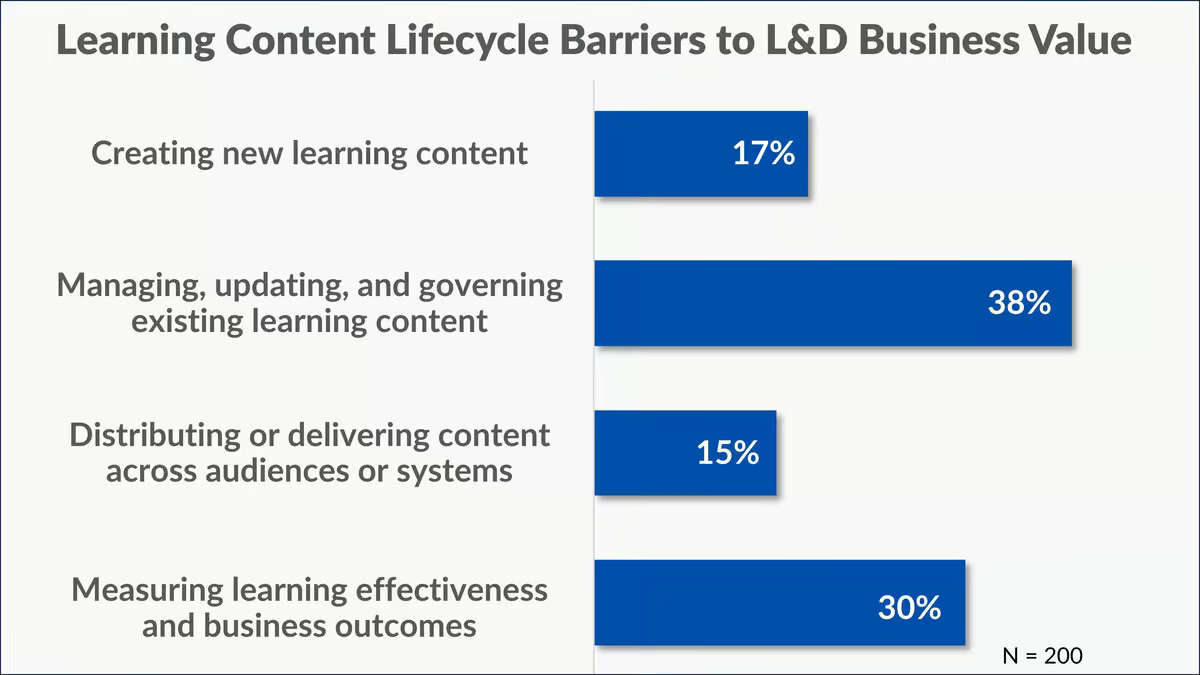
The supporting data:
- 74% of organizations say their current learning systems limit how efficiently they can manage and update content.
- 46% of active learning content is outdated, inaccurate, or in need of revision.
- Only 8% of L&D leaders feel their current systems deliver maximum value.
How this translated onto the floor of ATD ICE 2026
Practitioners and a notable number of decision-makers described spending more time hunting for the latest version of a course than actually improving it.
One of the strongest signals at our booth was interest in our content conversion capabilities. The dominKnow team can migrate an organization's entire Articulate Rise library (or others) into fully editable dominKnow | ONE content. For teams resigned to rebuilding their library to fix their content management problems, that's a game-changer.
That's not a feature request. It's a renewal-cycle conversation happening quietly across the industry.
Needs are changing. The Articulate Storyline session at ATD 2026 reportedly drew fewer than six attendees. For a tool that still dominates job postings, that's a leading indicator worth watching.
The operational tax nobody budgets for
The drain on practitioners is real.
Roughly 60–70% of an instructional designer's time goes to work unrelated to learning design, according to Jason Gorman. Hunting for assets, reformatting, managing review cycles.
That's a number you can take straight into a budget conversation. Every hour recovered from operational drag is an hour available for the strategic work your CHRO is already asking for.
Creating learning content is only half the challenge. Keeping it current, scalable, and effective is where organizations unlock real value. — Geoff Surkamer, CEO, dominKnow
There's a second consequence of AI-accelerated content creation that almost nobody on the floor raised out loud, and it carries the biggest risk attached.
The governance gap nobody put on the signage
Only 23% of L&D leaders are completely confident that their AI-generated content aligns with organizational policies.
Only 34% have tools that can enforce those policies in the first place, according to the State of Learning Content Management 2026 research.
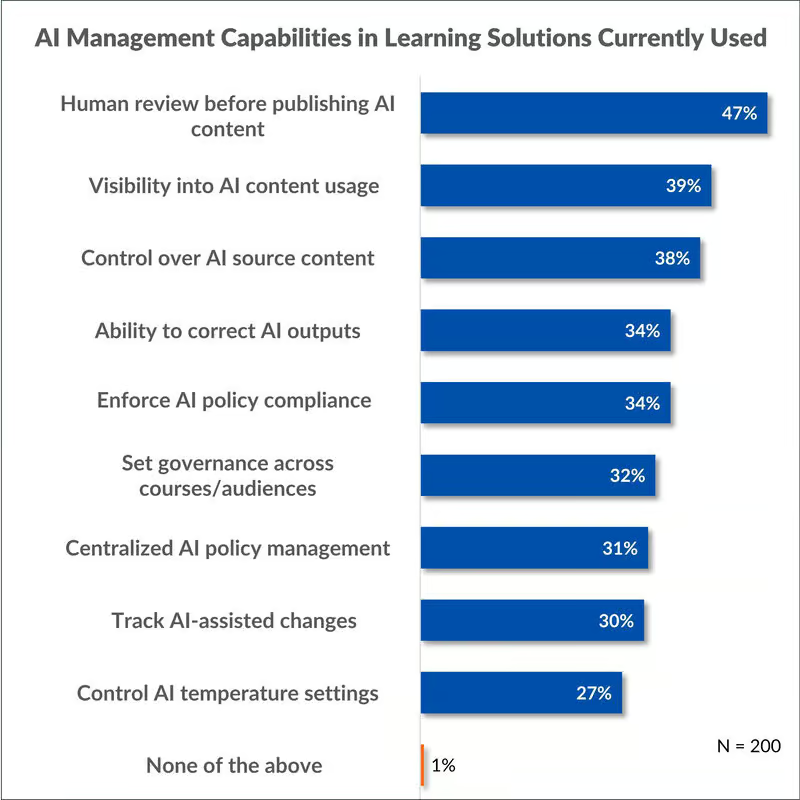
Think about that for a second.
More than three out of four learning leaders are deploying AI-generated content without full confidence that what reaches their learners meets their own compliance, brand, or accuracy standards.
The external research lines up. 52% of organizations cite accuracy and hallucinations as a top AI adoption barrier, and only 1 in 5 organizations have mature AI governance models.
As Craig Weiss noted in his ATD 2026 Expo Guide: no AI system, learning tech, or platform can claim 100% accuracy.
What duty of care actually looks like
Megan Torrance walked through a concrete example in our January 2026 IDIODC episode.
Her team deployed an AI practice module into a large, regulated environment, and built the safeguards to match.
You feel the difference the moment AI-generated content starts reaching your actual learners.
Her AI Implementation Canvas is built around the same kind of cross-functional conversation: bringing IT, legal, business sponsors, and L&D into the same room before an AI initiative scales.
AI adoption isn't just a technology project. It's a people and performance challenge. — Megan Torrance, CEO, TorranceLearning
For you, this is the executive frame that earns a seat at the AI governance table.
You're not asking for more budget. You're offering to lead the cross-functional conversation your CIO, CISO, and General Counsel are already struggling to coordinate.
What effective content operations looks like in the AI era
Stripped of vendor jargon, the platforms that handle this well share four traits.
Treat this as a checklist for your next vendor evaluation, system audit, or budget request. Not a feature wish list.
- Update once, propagate everywhere. A change to a policy, screenshot, or compliance statement cascades across every course, format, and audience that uses it.
- Visible version control and audit history. Every edit traceable. Every AI-assisted change reviewable. Rollback available when something falls short.
- Built-in review and approval workflows. Human checkpoints are structural, not optional. Especially for AI-generated content reaching learners.
- Flexible reuse across audiences, formats, and channels. Single-source content that publishes to web, mobile, SCORM, xAPI, and print without rebuilding.
AI amplifies what's already there. Better when the foundation is solid. Worse when it isn't.
The strategic frame to take back to your team
Stop being order-takers and start being strategic partners. — Debbie Richards, ATD 2026 wrap-up
The clearest message from ATD 2026 didn't come from any slide deck.
It came from the hallway conversations. You're being asked to deliver more, faster, with leaner teams, while the strategic complexity of your work keeps climbing.
AI didn't cause this shift. It's accelerating it.
You'll navigate the next 12–24 months well if you can name what's happening:
Creation has become easy to buy. The real difference now comes from how well you manage, govern, and position the content.
That's the vocabulary you bring to your CFO, CIO, and CHRO conversations. Backed by research and proof points.
Resources from the work behind this article
- 📘 The State of Learning Content Management 2026 report: full data set and benchmarks
- 🎥 The L&D Professionals' Guide to AI Strategies webinar with Megan Torrance
- 🎙️ The IDIODC episode with Megan Torrance: the conversation L&D teams should be having about AI
Get your content ops under control
Curious how this would look with your own content?
Request a demo of dominKnow ONE. We built our LCMS platform around the problems this article describes.
What comes next for your team won't be decided by which tool you pick. It will be decided by how you choose to operate.