


.svg)

.svg)


Build Once, Deliver Everywhere: Why Single Source Course Design Is the Future of L&D



Summary
Learning teams are under increasing pressure to deliver more training, faster, and to more audiences than ever before. Yet many organizations still create separate versions of the same content. In this article, we'll explore what single-source design is, why it matters, and how it helps learning teams create eLearning content and training resources more efficiently.
What is single-source design in learning and development?
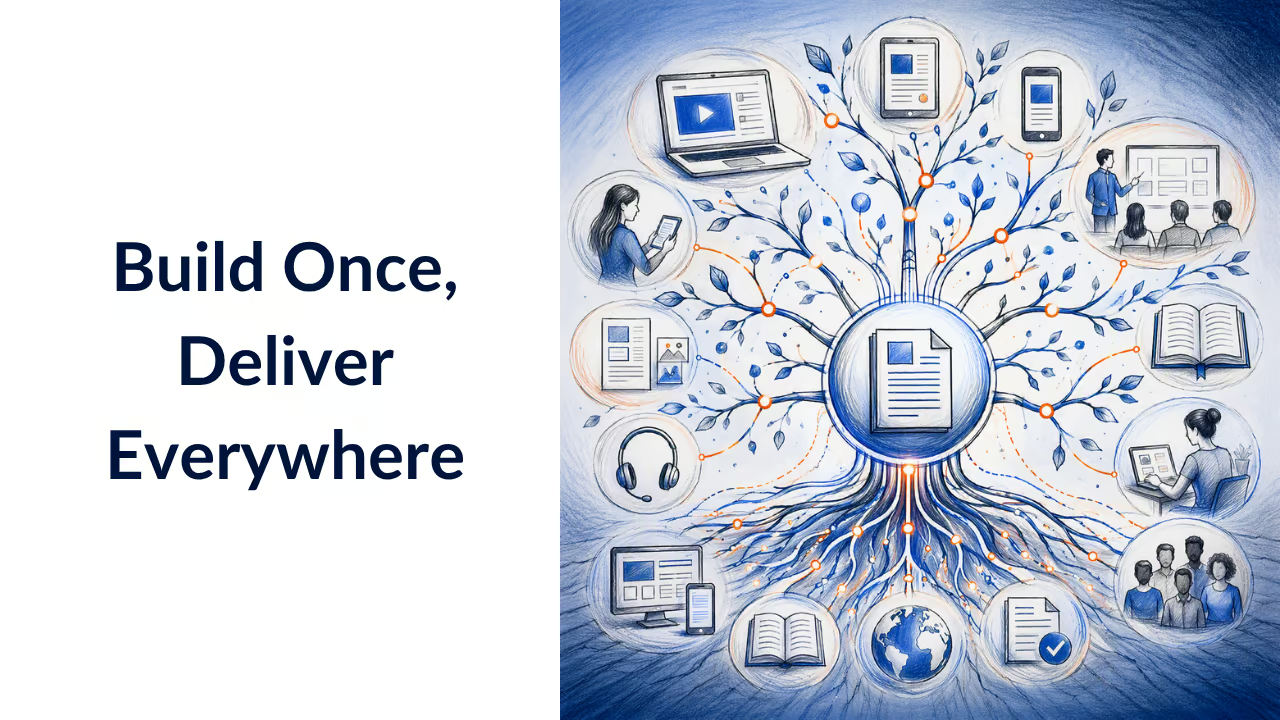
Single-source design is an approach where learning content is created and managed from a single project or source file, then published into multiple delivery formats.
Instead of building separate versions of a course for different learning experiences, teams create core content once and configure it for different use cases.
For example, a single-source project might entail the initial creation of one eLearning course, from which an instructional designer can generate:
- Instructor-led training (ILT) facilitator materials
- Learner guides and participant workbooks
- Virtual classroom resources
- Standalone microlearning modules
- Job aids and performance support materials
- Translated versions of the same content
The core information remains consistent, while the presentation and delivery can adapt to the needs of each audience or learning environment.
Why is creating separate ILT and eLearning courses inefficient?
Many organizations still follow a traditional workflow for learning content creation:
- Design an ILT course
- Create facilitator materials
- Create learner materials
- Build a separate eLearning version
- Translate each version independently
- Update every asset whenever content changes
The result is a growing collection of disconnected content that requires continuous maintenance. For instance, if the ILT session covers industry-specific legislation, and there is an update before the live session, the L&D team will need to update every piece of content separately. This is time consuming, and introduces many more opportunities for human error, such as if one piece of content is missed.
When regulations change, processes evolve, or products are updated, learning teams simply don’t have time to edit multiple versions of multiple files every single time. It adds to development time, drives up maintenance costs, slows down update cycles, and creates a greater risk of inconsistencies, which in turn leads to significantly greater effort for already overstretched learning teams.
As organizations grow, these inefficiencies become increasingly difficult to manage – especially when multiple platforms, audiences, and languages enter the mix.
How does single-source design reduce learning development effort?
Single-source design eliminates much of the duplication involved in traditional course development. Rather than rebuilding the same content for different formats, instructional designers work from one centralized source.
This means teams can:
Create content once
Subject matter expertise, learning objectives, assessments, and core instructional content are developed a single time.
The content can then be reused across multiple learning experiences without duplication.
Update content in one place
When changes are required, designers make updates once, and publish them everywhere the content appears, such as on the Learning Management System (LMS), on the website, or on standalone URLs.
This dramatically reduces maintenance effort and helps ensure accuracy.
Accelerate course production
Because content is reused rather than recreated, development timelines become shorter and more predictable.
Learning teams can respond more quickly to business needs while maintaining quality.
Can single-source design support both ILT and eLearning?
Yes – and this is where single-source design delivers some of its greatest value.
Although ILT and eLearning share much of the same foundational content, they often require different learning experiences.
For example:
An instructor-led course may include:
- Facilitator notes
- Classroom activities
- Group discussions
- Presentation materials
While an eLearning course may require:
- Interactive activities
- Knowledge checks
- Self-paced navigation
- Digital assessments
With a single-source approach, the underlying content remains connected while specific elements are adapted for each delivery method.
This allows organizations to support blended learning strategies without maintaining multiple independent courses. The single-source approach means an instructional designer can create one “master course” and remix it into multiple formats, which can then be updated simultaneously.
How does single-source design support multiple languages?
Global organizations often face another major challenge: translating learning content.
Traditionally, every language version becomes a separate project that must be updated and maintained individually.
Single-source design simplifies this process by keeping content centrally managed while supporting localization workflows.
Benefits include:
- Faster translation updates
- Greater consistency across languages
- Reduced translation costs
- Easier management of global learning programmes
When source content changes, updates can be pushed through translation workflows more efficiently than maintaining multiple disconnected files.
This helps organizations deliver learning at scale across regions without creating unnecessary administrative burden.
Need to translate your single-source learning content? dominKnow | ONE’s AI Translator gives you your fastest, easiest translations yet.
Can single-source design support different audiences?
Not every learner needs exactly the same learning content.
Sales teams, managers, frontline workers, and technical specialists may require variations of a course while sharing common foundational knowledge.
Traditionally, this often leads to separate courses being created for each audience. This puts an unnecessary burden on the instructional design team, who spend a lot of time duplicating content and managing updates across multiple courses – and maybe even multiple courses in multiple languages.
Single-source design enables learning teams to maintain shared content while tailoring specific sections to different learner groups.
For example:
- Regional compliance differences
- Role-specific examples
- Department-specific processes
- Audience-targeted scenarios
Instead of creating entirely separate courses, teams can manage these variations from a common content source, improving consistency while reducing development effort.
Why is single-source design more scalable?
Scalability is one of the biggest challenges facing modern learning teams.
Training programs often need to expand across:
- New regions
- New products
- New business units
- New delivery formats
- New learner audiences
Without a scalable content strategy, every expansion increases complexity.
Single-source design provides a foundation for growth because content can be reused, adapted, and published in multiple ways without starting from scratch.
As learning programs evolve, organizations can:
- Launch training faster
- Reduce operational overhead
- Improve content governance
- Maintain consistency across experiences
The result is a learning ecosystem that can grow without requiring proportional increases in development effort.
What makes single-source design different from traditional authoring?
Many eLearning authoring tools allow content reuse in limited ways. However, true single-source design goes beyond simple copy-and-paste reuse.
The most advanced approaches allow teams to:
- Manage content from a single project
- Publish to multiple outputs
- Support ILT and eLearning from the same source
- Deliver audience-specific variations
- Support multilingual learning programmes
- Update content centrally
This capability remains relatively uncommon within the learning technology market, despite the significant efficiency benefits it can provide.
For organizations focused on scale, governance, and operational efficiency, single-source design represents a fundamentally different approach to learning content creation.
The dominKnow | ONE LCMS offers single-source content design to support:
- Multi-format publishing
- Creating a knowledge base from your existing content
- eLearning content authoring
- Simulation creation
- Scenario branching
- Gamification
- Video interactivity
- Collaboration, review, and approvals
dominKnow | ONE’s approach to single-source content unlocks efficiency, streamlines content workflows, and ensures quality and consistency across every course and resource.
Frequently Asked Questions

Single-source design is a content development approach where learning content is created once and published into multiple formats, audiences, or languages from a single source project.
Yes. A single content source can be adapted for instructor-led training, virtual instructor-led training, self-paced eLearning, learner guides, and facilitator materials.
Yes. Updates are made once in the source content rather than separately across multiple course files, reducing maintenance time and improving consistency.
By eliminating duplicate content creation and maintenance, learning teams can support more audiences, formats, and languages without significantly increasing development effort.
By eliminating duplicate content creation and maintenance, learning teams can support more audiences, formats, and languages without significantly increasing development effort.
Single-source eLearning content: final thoughts
As learning teams face growing demands to deliver more training with limited resources, efficiency has become just as important as instructional quality.
Single-source design helps organizations reduce duplication of effort, streamline maintenance, support multiple delivery formats, and scale learning programs more effectively, saving both time and budget and freeing up instructional designers to focus on more important tasks.
Rather than creating and managing separate versions of the same content, teams can build once and publish everywhere it's needed, using tools like dominKnow | ONE.
For organizations delivering ILT, eLearning, multilingual training, and audience-specific learning experiences, single-source design offers a smarter, faster, and more sustainable approach to content development.
Want to see how it works for yourself? Start your dominKnow | ONE free trial today to see how quick and easy single-source eLearning design can be.