


.svg)

.svg)


Why Most eLearning Assessments Fall Short: How AI Is Finally Fixing That



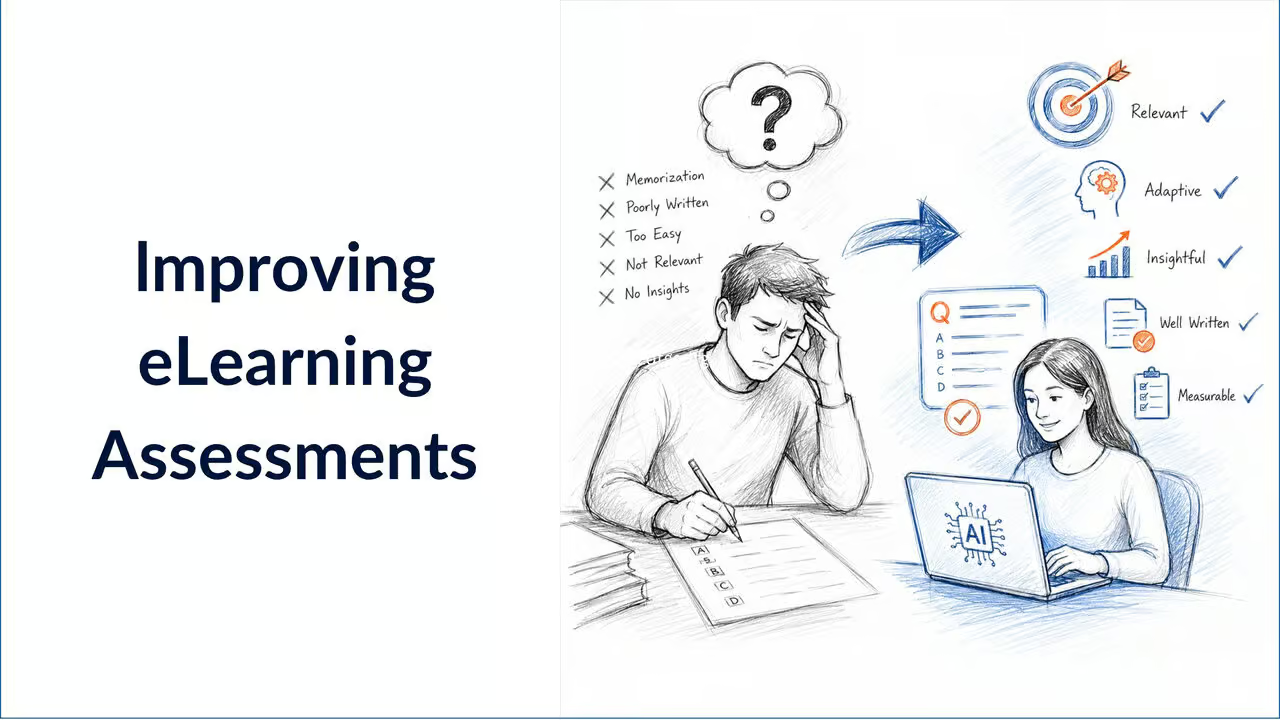
The Measurement Gap Is Real
According to GP Strategies 2025 research, 98% of organizations want to measure learning impact. Only 24% have a dedicated budget to do it.
That is not a priorities problem. That is a tools problem.
Completion rates and quiz scores tell you almost nothing about whether someone can perform when it matters. And the stakes are high. A 2026 Enterprise L&D survey found that 56% of L&D professionals rank strategic and critical thinking as the number one skill their organizations need right now. Those aren’t skills you can verify with a ten-question multiple-choice quiz.
It gets worse on the analytics side. Only 14% of L&D teams report advanced analytics capability(GP Strategies 2025). The other 86% are running basic dashboards, tracking pass rates and completion timestamps, and calling it measurement.
The gap between the data that is easy to collect and the data that matters is exactly where AI-powered assessment design creates the most value.
Three Things Jobs Assessments Should Do
Most organizations only accomplish one of these three.
- Confirm Understanding. Did the learner get it? Not just sit through it.
- Build Confidence. Can they act on what they learned when the moment arrives?
- Provide Business Intelligence. Can leadership trust that this workforce can perform the task under real conditions?
The standard end-of-course quiz barely handles the first one. It tells you someone selected the right option from a list. It tells you nothing about whether they can handle a difficult customer complaint, apply a data privacy rule in an ambiguous situation, or give constructive feedback with empathy under pressure. The checkbox tells you which option they picked. What the business needs to know is how they would respond in a real conversation.
The Recognition Problem
Multiple-choice questions test recognition: the ability to identify the correct answer when it’s already in front of you. What organizations need real evidence of is production: the ability to generate the right response from memory, in a real situation, with no options on the screen. The cognitive science on this is clear. Producing an answer creates stronger, more durable memory than selecting one. The struggle to recall and construct a response is what builds the kind of retention that transfers to the job. Learners recognize this intuitively. In one deployment, when asked what they valued most about their course, a learner responded without prompting: “It was harder to come up with the right words than just to select the right words, but it was more realistic. ”The shift from recognition to production is the most important design move in modern assessment. AI is what makes that shift scalable.
What AI Coaching Is — and Is Not
AI coaching in eLearning is not a chatbot. It is not pasting a scenario into ChatGPT and hoping for useful feedback. Here is how it works inside a course:
- Learner Writes. An open-text response to a realistic scenario prompt. No options to select. Their own words.
- AI Evaluates. Against your rubric, your frameworks, your approved criteria. The AI applies your organization’s standards, not generic ones pulled from the open web.
- Feedback Returned. Personalized coaching that is multi-dimensional and instant. The kind a skilled facilitator would give after reading carefully.
No facilitator delay. No generic “Try Again.” No manual review of every response. Three steps, zero delay, and it scales to 2,000 learners as easily as one. One important guardrail: strong AI coaching runs in a closed sandbox. The AI references only content the organization has approved. In regulated industries, that distinction matters a great deal.
Does It Work? The Data Says Yes.
Gupta presented deployment data from Artha Learning across real client courses at Iowa State University, The France Foundation, and GardaWorld. The results were consistent:
- 87% of learners satisfied with AI-powered practice and feedback (52% extremely satisfied)
- 94.6% reported confidence in the target skill after completing the course
- 60% of learners answered an open-ended question about what they valued most, with no mention of AI in the prompt. Every one of them spontaneously named the AI practice or personalized feedback as the most valuable part of the course
That last number is worth pausing on. Not prompted. Not a leading question. Learners arrived at that answer on their own. As Gupta put it during the webinar: when learners have to produce the right words instead of selecting them, that struggle is the learning. Practice creates the evidence that content alone never can. The whitepaper behind this data, Practice, Not Content: The Evidence for AI Coaching in Learning and Development, is available at dub.sh/aipractice.
Connecting Assessment Data to Business Outcomes
Better assessment data is only useful when it connects to something the business already tracks. There are two ways to get there.
Translation means taking assessment evidence and reframing it in business terms. A scenario-based assessment on customer de-escalation becomes a defensible proxy for real call outcomes. Strong performance in the scenario becomes a credible indicator of on-the-job readiness.
Direct Alignment means designing the assessment from the start to measure something leadership already monitors: escalation rates, error rates, incident response times, customer satisfaction scores. Either approach requires richer data than pass/fail. That is where xAPI becomes essential.
With xAPI, learning teams capture detailed statements about what learners did, how they responded, and where they struggled. That data sits alongside the business metrics leadership monitors, rather than isolated inside an LMS report no one reads.
Only 14% of L&D teams have the analytics infrastructure to do this today. The teams building it now will have a significant advantage in the next budget conversation.
Respecting Learner Time with Pretests
Here is a stat worth sharing with every stakeholder who questions the investment in better assessment design: 42% of L&D professionals cite lack of learner time as the number one barrier to effective training(CIPD 2023).Smart pre-testing addresses this directly. Rather than sending every learner through the same content regardless of what they already know, pretests route people based on actual gaps. With dominKnow | ONE, teams can configure pretests to:
- Route learners directly to the content gaps they have
- Allow experienced employees to test out of content they have already mastered, with completion marked automatically
- Set separate pass scores for pre-tests and post-tests so measurement is meaningful at both ends
- Exit the course immediately when a passing score is no longer achievable, rather than forcing learners to finish
Seat time goes down. Relevance goes up. The data from both ends becomes genuinely useful for tracking growth over time.
What dominKnow ONE Makes Possible Today
dominKnow ONE is an award-winning LCMS platform built for the full learning content lifecycle: create, manage, and deliver learning at scale. For assessment strategy specifically, here is what is available today, not on a future roadmap.
AI-coached open-text scenarios. Through Flow authoring and AIready integration, learners respond to scenario prompts in their own words inside the course. Rubric-based feedback returns in real time. No custom development required.
Advanced pre-testing. Optional or required pretests, separate pre- and post-test pass scores, timed testing, review controls, immediate exit when passing is no longer possible, and test-out completion for learners who already know the material.
xAPI built in. Pre-made statements for standard learner activities including media consumption, button selections, and interactive components. Custom statements available for scenarios, AI coaching scores, and branching paths. SCORM and xAPI can run simultaneously to multiple learning record stores.
Role-based branching. One course, multiple paths based on learner role. Compliance training that reflects what a person’s actual job looks like, rather than a generic scenario that applies loosely to everyone.
Story-threaded assessment sequences. Connected scenarios where decisions have delayed consequences. Learners stay engaged because choices made early in the course surface later, which is exactly how real decisions work.
The Bottom Line
Content alone is not enough. Assessments are the bridge between delivery and actual learning. Every L&D priority ultimately comes down to the quality of decisions your people make on the job. AI removes the barrier that made high-quality, personalized practice impossible to deliver at scale. dominKnow | ONE provides the platform to put that into practice starting today.