


.svg)

.svg)


See what dominKnow | ONE can do for your team.
See what dominKnow | ONE can do for your team.
See what dominKnow | ONE can do for your team.
See what dominKnow | ONE can do for your team.
dominKnow is a cloud-based Learning Content Management System (LCMS) built for enterprise training teams that need structured content reuse, collaborative course authoring, and scalable multi-channel publishing.Unlike traditional LMS platforms that focus only on delivery and tracking, our enterprise LCMS software centralizes the creation, management, and governance of learning content. Create once, reuse intelligently, publish everywhere.For organizations managing compliance programs, multi-language training, and global learning initiatives, dominKnow eliminates duplication, accelerates updates, and improves consistency across all digital learning content.If you are evaluating LCMS vendors or comparing an LCMS vs LMS strategy, dominKnow provides the structured content management foundation enterprise teams require.Learning content management system software helps enterprise organizations centralize content creation, reuse structured learning objects, and publish compliant training content at scale. A cloud-based LCMS supports collaborative course authoring, governance workflows, and efficient publishing to SCORM and xAPI formats.
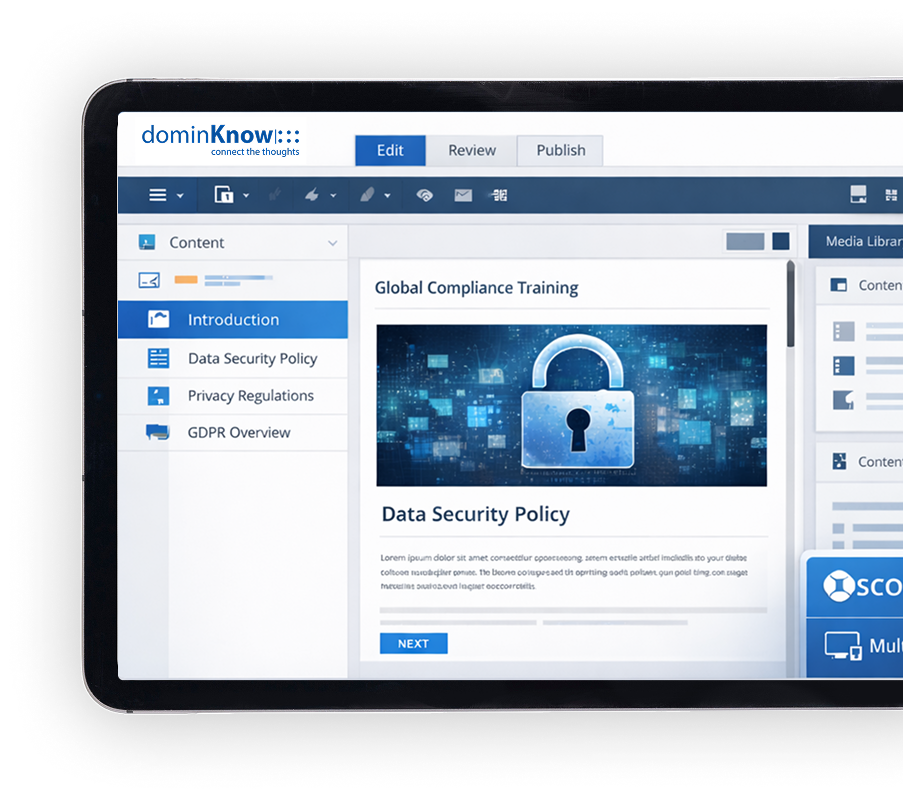
A Learning Content Management System, often abbreviated as LCMS, is a platform designed to create, manage, reuse, and publish structured learning content at scale. While a Learning Management System (LMS) delivers courses and tracks learner progress, an LCMS manages the learning content itself. It provides collaborative authoring tools, centralized content libraries, metadata tagging, workflow approvals, and single-source publishing capabilities. Enterprise organizations rely on LCMS software to reduce content duplication, streamline regulatory updates, and support multi-brand or multi-region training programs.
.png)
The difference between a Learning Content Management System (LCMS) and a Learning Management System (LMS) is one of purpose and architecture. An LCMS is built for content creation, structured reuse, and governance. An LMS is built for course delivery and learner tracking. When organizations search for “LCMS vs LMS,” they are often trying to determine whether they need content control or learner administration. An enterprise LCMS enables instructional designers to collaborate, reuse content components, and maintain version control across large training ecosystems.
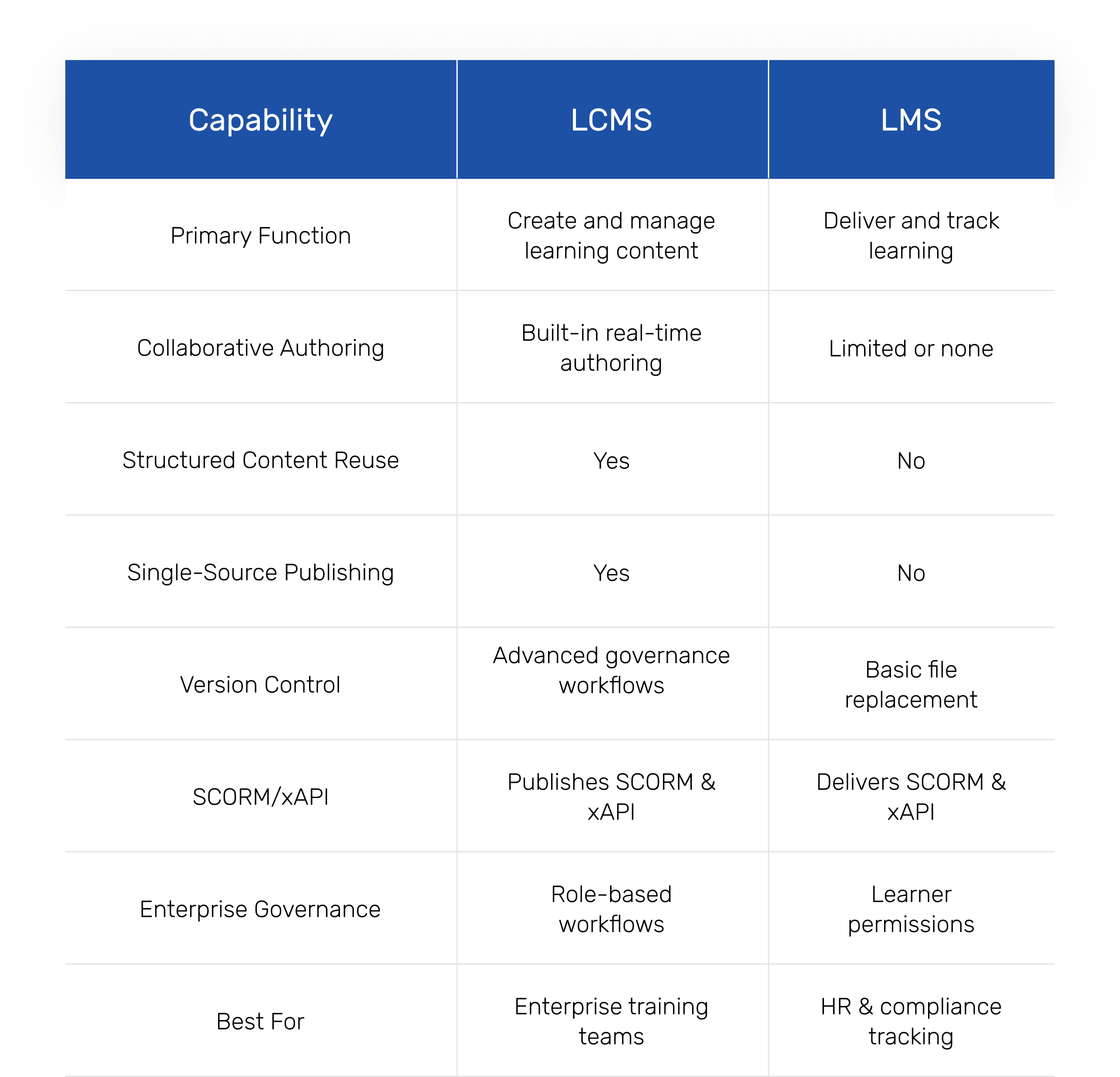
Enterprise teams typically need an LCMS when they create large volumes of training content internally and must keep it accurate across programs, regions, and languages. If your organization requires structured content reuse, version control, and governed approvals, an enterprise LCMS provides the content operations layer an LMS does not. An LMS is best suited for learner enrollment, delivery, and reporting. An LCMS is built for content creation, governance, and scalable publishing. Many organizations use both together: the LCMS manages the content lifecycle, while the LMS handles distribution and learner tracking. For scalable learning content management, most enterprise organizations deploy an LCMS alongside an LMS rather than choosing one over the other.
These challenges are common in large enterprises evaluating learning content management system solutions. Without a centralized enterprise LCMS, training teams face rising operational inefficiencies and compliance risk.
Structured content reuse is the foundation of a modern Learning Content Management System. Instead of building full courses as isolated files, content is developed as modular components that can be reused across multiple learning experiences.
For example, a compliance policy block may appear in 12 different courses. In a traditional LMS-based workflow, updating that policy requires editing all 12 files individually. In an LCMS with structured reuse, the content block is updated once, and all connected courses automatically reflect the change.
This capability significantly reduces maintenance effort, improves consistency, and minimizes compliance risk. Single-source publishing extends this advantage by enabling organizations to publish SCORM compliant LCMS packages, xAPI content, and web formats from the same structured source. For enterprise teams managing high-volume digital learning ecosystems, structured content reuse is not optional. It is essential for scalability.
With single-source publishing, enterprise teams can maintain one governed source and output multiple delivery formats without rebuilding the course for each platform.
See how structured content reuse reduces updates and improves consistency across programs.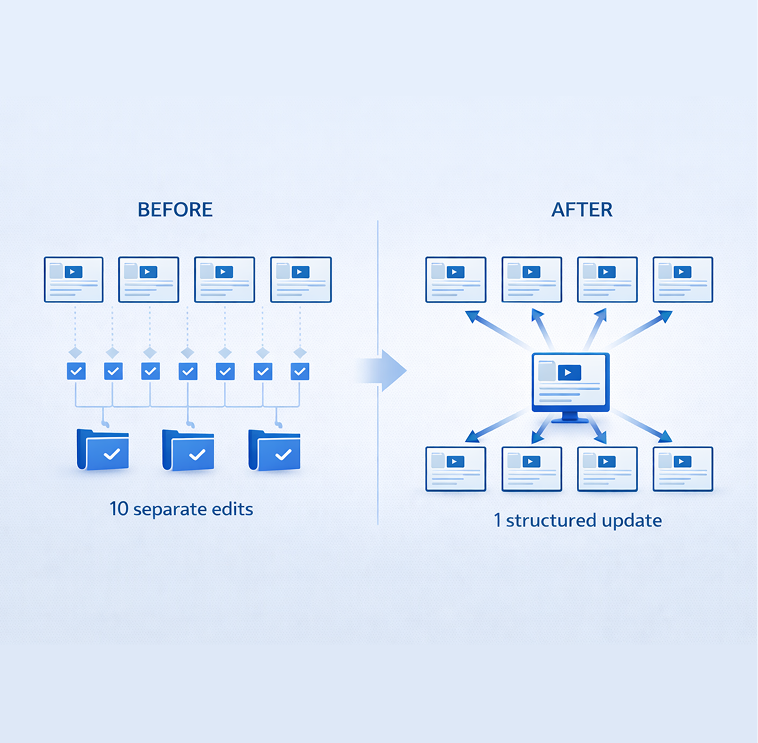
.png)
Standardize safety and operational training across facilities while reducing duplication.
Maintain regulatory compliance and update clinical training instantly across departments.
Centralize certification updates and ensure policy alignment across global branches.
Manage policy-driven training programs with audit-ready version control.
Scale product and customer education programs globally with structured content reuse.
dominKnow integrates seamlessly with leading Learning Management Systems, HR platforms, Single Sign-On providers, and reporting tools. Publish SCORM compliant LCMS packages directly into your LMS. Deliver xAPI compatible content for advanced analytics environments. Leverage API connectivity to extend learning content management across your digital infrastructure. A flexible integration framework ensures your enterprise LCMS complements, rather than replaces, your existing learning ecosystem. dominKnow also supports Learning Record Store (LRS) workflows for xAPI tracking and integrates with enterprise SSO providers to simplify secure access. (If you don’t want to mention LRS, delete “Learning Record Store (LRS)” and keep “xAPI tracking and enterprise SSO”.) Explore how dominKnow fits into your LMS, HR, and enterprise security stack.
.png)
dominKnow applies AI to accelerate metadata tagging, content organization, and findability within large enterprise content libraries. Intelligent suggestions accelerate course development workflows. AI-enabled metadata organization enhances search accuracy and retrieval speed. As enterprise organizations adopt AI across digital operations, integrating AI within LCMS software ensures future-ready learning content management. dominKnow incorporates AI-enhanced capabilities to improve efficiency while maintaining structured governance and enterprise oversight.
.png)
dominKnow is a secure cloud-based LCMS built to support enterprise compliance requirements. Role-based permissions ensure controlled access across teams. Version control and workflow approvals maintain structured governance. Audit logs provide visibility into content changes and approval history.
Secure hosting infrastructure and encryption standards protect learning content while enabling global collaboration.
For organizations prioritizing compliance and security, enterprise-grade governance is built directly into the platform.
When evaluating LCMS vendors, enterprise organizations should look beyond basic authoring tools. The best learning content management system options provide structured content reuse, single-source authoring, governed workflows, and publishing standards support. Key evaluation areas include SCORM compliant LCMS publishing, xAPI compatible LCMS delivery, integration flexibility with your LMS and learning ecosystem, and permissions that support distributed teams. dominKnow is built for enterprise learning content management at scale, helping teams reduce duplication, accelerate updates, and maintain governance across global programs.
.png)