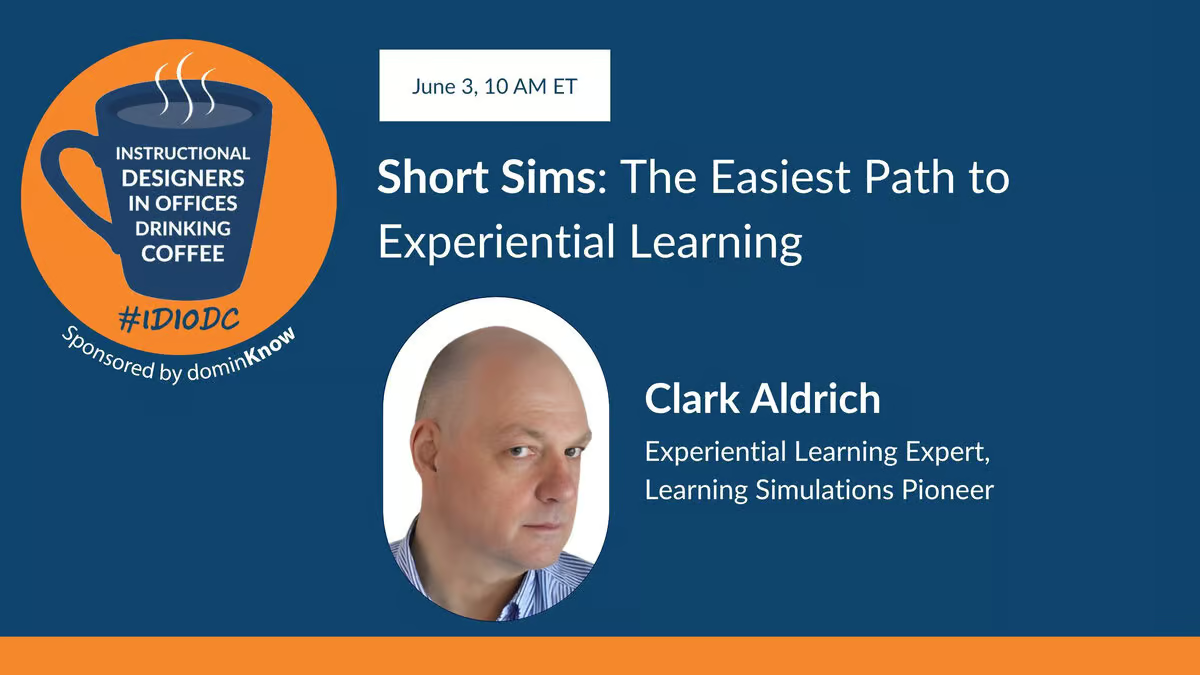
[00:00] Chris Van Wingerden: Welcome to Instructional Designers in Offices Drinking Coffee. This show is sponsored by the team at dominKnow, helping L&D teams develop, scale, and deliver learning that maximizes employee value.
[00:56] Chris Van Wingerden: Today we have a special guest, Clark Aldrich. Clark, you have been with us before, but there might be folks in the crowd who have not met you yet. Introduce yourself.
Clark Aldrich: My name is Clark Aldrich, and I work really hard on trying to figure out how to do experiential learning. For almost 30 years I have been trying to figure out why schools cannot teach leadership, and if not, how do we teach experiential learning? That has taken me down all kinds of paths, including down the Short Sims path.
[01:26] Chris Van Wingerden: A running thread in our conversations is about the nature of content that L&D teams have to make. Someone gives us a bunch of information and we try to push it into the brains of our audience. But our job is really to change behavior. Why does just giving people a bunch of PDFs with information not meet that mark?
Clark Aldrich: We have all these linear content models and we know they do not work. We sit and look at a PowerPoint slide or read a PDF written in a traditional data dump analysis way, and it does not change behavior. We know that. Workbooks, essays, lectures, tests — all of our old methods are falling by the wayside as being inefficient. The problem is not just what we produce but how we research. How we interview and what we look for when we interview is a whole different thing when you shift to Short Sims.
Chris Van Wingerden: You mean the 10-question quiz at the end of a half-hour course does not demonstrate that someone has learned, let alone can apply something on the job?
Clark Aldrich: It can, if you do it really carefully. But most of the time we do not even research for actions. We research for broad analysis. Having spent time as a Gartner analyst, I am as guilty as anyone. It is just a bad methodology. We need to move away from workbooks, essays, lectures, and tests, and move toward methodologies like Short Sims. Almost nothing matters more than changing the research process.
Paul Schneider: At the Canadian eLearning Conference, someone had built a new system around two key principles: spaced learning and experiential learning. It is rare to run into somebody who did not believe that practicing something or having a simulation was a better experience. The research supports it and people believe it is good. So why is it not used more often?
[04:29] Clark Aldrich: If you say the word simulation to five people in a room, everyone will think of something different — and frankly, they will think of something really expensive, complicated, and time-consuming to create and audit. Everything in training has to get audited, and traditional uber-simulations are impossible to audit. If you put a flight simulator on someone’s desk and say sign off on this, they never will.
Clark Aldrich: I built a really complicated AI-driven simulation called Virtual Leader with 50,000 lines of AI code. It was wonderful, but it was hard to deploy, hard to update, and very hard for any company to audit. Computer games as a model for experiential learning is actually a terrible model because it leads you to make all the wrong decisions.
Clark Aldrich: When I moved from building complicated AI-driven 3D simulations to Short Sims, I had specific goals: bulletproof, as simple as possible, and auditable. But there is one more critical thing — things do not catch on unless everyone can do them. Virtual reality is so difficult because you cannot create three or four great examples of exotic technology and expect it to catch on. We have PowerPoint slides because there are so many of them. We have videos because there are so many of them. You need volume. The format has to be bulletproof to deploy, almost lowest common denominator like email, something reusable, and something where the door is open to make hundreds or thousands of them.
[06:37] Chris Van Wingerden: If someone is looking at taking on their first simulation, moving from the content dump and 10-question quiz to thinking about simulations — what checklist would you give them to prioritize where to start?
Clark Aldrich: A good Short Sim takes about 35 to 40 hours of labor to create a 10-minute experience. It is a chunk of time but not that much. Just start doing things. It works really well with certification skills, soft skills like leadership, interpersonal skills, and sales skills — anything you are excited about. The goal is not to create one Short Sim. The goal is to create 10, 15, or 20. Every one you create will be frustrating because you will be leaving three or four others on the table until you finish that one. The only important thing is to start.
Clark Aldrich: If you have a good subject matter expert, that is nice. Organizational need is the most important factor, but even if you have an incredible need for something, you may not want that to be your first one. Make all your mistakes in a safer space before the entire company is watching. Chuck Jones, the famous animator of Bugs Bunny, said every artist has 10,000 bad illustrations in them and the only thing you can do is draw them out. Allow yourself to make stupid mistakes. Most people’s first mistake is trying to be too complicated. Limiting yourself to being much simpler than you think you have to be will get it done. It is like the military: start every plan simple. It gets complicated enough on its own.
[09:16] Paul Schneider: Can you provide a description or example of what happens in that 10 minutes?
Clark Aldrich: One sim I did was around robberies — helping bank employees deal with robberies. The question was: what are the common types of robberies? That became about a 12-minute sim with four mini-scenarios. There is the morning glory, where the first employee of the day gets held up as they go into the bank. There is the ransom note robbery, and so on. You take someone through different experiences, and each experience has four or five decision points along the way. You end up with a handful of characters, a handful of props — in this case the robbery form you fill out afterwards — and you build the set, which is the bank.
Clark Aldrich: If you go to shortsims.com and look at the Commission Custom Short Sims page, it has a breakdown of a typical sim in terms of number of characters, scenes, and amount of dialogue. It also has a timeline and what the client provides versus what the sim designer creates. It is a useful resource to understand what a Short Sim involves.
[10:43] Chris Van Wingerden: A viewer asks: what are the criteria that make a good simulation?
Clark Aldrich: Anytime there is real-world behavior change — leadership, technical, certification, whatever — anytime there is application of content. One way to think of a sim, including a Short Sim, is just a synthetic experience. You give someone an experience before they have to do it for real, where they can make all their mistakes. Anytime you want to actually change behavior, simulation should be the first thing you consider.
Chris Van Wingerden: If you have a limited simulation budget, high-stakes situations where lives might be at risk — where you do not want people guessing the choices — might be a useful filter for where to focus first.
Clark Aldrich: High-stakes, low-probability activities have traditionally been a good fit. That is where a lot of early simulation work was done — flight simulators, nuclear power plant simulators, Wall Street simulators, bridge simulators. But a lot of sims are also just for day-to-day stuff: how do you deal with your employees as a leader to keep them motivated, engaged, and finding meaning and purpose in their work? There is a place for both the super high-stakes sims and the day-to-day ones. Anytime you want to actually change behavior, simulation should be the first thing.
[13:59] Paul Schneider: What are some examples where you could tell a simulation was going in the wrong direction, and what are the signs that it is going in the right direction?
Clark Aldrich: The research process for a Short Sim is straightforward: give me a subject matter expert for one hour. I will ask a ton of questions, and the most important one is not what is the right way to do this, but what are all the wrong ways people do this in the real world? Most SMEs are really happy to talk about that. You get a long list of screw-ups, then you identify a scenario and put in opportunities to make every mistake possible — 12 or 13 of them.
Clark Aldrich: Then there is a calibration phase: is this too hard, too obscure, or are we setting people up to fail? The calibration process is like making a movie. You play through the sim again and again. Most of the time when I am reviewing a sim, I am taking out words. Branching stories came before Short Sims and were a good model, but most branching stories have too many words, are too confusing, and do not have enough visual scaffolding. The design principle of Short Sims is show do not tell. In a good sim it is: play, do not talk at people. Let them experience it for themselves.
Clark Aldrich: Long-term, one client rigorously measured the impact by tracking real-world behaviors. Over five or six years of annual course refreshes, they steadily replaced workbook content with more Short Sims — from one sim in the middle of a course to basically all Short Sims. When Short Sims focused on a behavior, the number of mistakes made in real life went down dramatically. If you allow people to practice behavior with feedback, they do get better at it.
[15:59] Chris Van Wingerden: A viewer in the chat points out the value of compressing time in a sim — experiencing the ramifications of decisions that might be delayed by days, weeks, or months in real life.
Clark Aldrich: You can compress time, which is probably the most useful thing. You can also see reactions that you cannot actually see in the real world. If you are a manager ordering everyone around, everyone might say you are so smart in the moment — but in reality, five other conversations are happening where people are saying the opposite. In a sim, you can zoom out and see those reactions. You can also add a bit of bad luck to a scenario: this might have worked most of the time, but here is something that could have been avoided. Short Sims are as good for getting rid of bad habits as they are for adding good habits. We develop bad habits because they have worked for us short-term. The long-term consequences only become visible with time compression — and that is exactly what sims provide.
Clark Aldrich: The Short Sim philosophy is: once you make a mistake, get people back on the right trail very quickly. Explain why it was a mistake — not just you broke policy 432, but here is what happened as a result. Having a very short feedback cycle is critical from both a pedagogy and a designer perspective. But the right behavior is not always the right behavior. In a leadership sim, the options might be: micromanage, delegate the process, or delegate the objective. The right answer changes every time depending on the employee and their situation. That is the right answer in the right context.
Clark Aldrich: People love Short Sims when they are done well. Traditional content freaks people out because they do not know what it feels like to apply it. Until you practice something, you do not own it — you are just leasing the content. The native tongue for humans is experiencing something, not sitting through a lecture. Empathy for mistakes is a really important sim designer quality. Present the sim not as a big red X saying you violated policy 432, but as: I understand what you did, and what you did made sense except for this one thing. Zooming into the messiness is a really important part of sim design.
[28:33] Paul Schneider: How do you see AI being used in simulations, and what are the advantages compared to traditional methods?
Clark Aldrich: Free text versus clicking a button — the illusion is that free text is more authentic. The negative is that it takes away the hard decisions. In a sales call, at some point you have to decide: am I going for the close right now or not? Those hard decision points are where actual learning happens. With free text you can mumble through things and not be sure why you got something right or wrong. One test for a good sim: if I play it over again, will I make the same mistakes? Hopefully not. There is an illusion of customization and authenticity with free text, but it quickly becomes a mumbly situation where you are not sure what you learned. It is like the old saying: a jumbo jet is a terrible place to learn how to fly. Too many options means you cannot have a closed enough feedback loop to give customized feedback. AI can be very squishy, and feedback for a middle-of-the-road response can be unhelpful.
Clark Aldrich: AI is helpful to augment sim design, but the real-world SME’s experience should be the foundation. Academic experts are fairly useless here — I want real-world experts. The most important thing about AI and sim design: AI has been trained on linear content, not interactive content. AI is heavily biased toward a linear presentation, toward the one brittle path to success. If you are a first-time sim designer, build your first five sims without any AI at all, then use AI for art and props mostly, not for the actual interactions.
Clark Aldrich: You can use AI well if you give it very specific variables. Think of a good Short Sim as almost making a computer game. Prompt the AI not as a co-writer but to think about words and dialogue in the context of specific variables you set — for example, this character is currently at a 3 out of 10 in frustration, write dialogue that meets that criteria. AI works when you give it specific constraints.
Clark Aldrich: AI also speaks with an accent. Once you recognize that accent you start phasing out. People are very good at reverse-engineering intent, passion, and humanity, and once that is no longer there they phase out. More and more people are glazing over when they start hitting AI phrases and AI terms. That is a real problem for learning content that needs to hold attention.
Paul Schneider: AI-generated content almost always sounds great. But if you are not the SME, subtle inaccuracies can compound into problems. Using AI to prepare for SME conversations is a great use case — but if the SME is just phoning in their review, a lot can be missed because the AI output looks good even when it is slightly wrong.
[35:58] Chris Van Wingerden: What is the number one thing to avoid when starting down the Short Sims path?
Clark Aldrich: Start off small and simple. In the first half of the Short Sim design process, fight your instincts and be as simple as you can. The second half will add plenty of complexity on its own. The first race in sim design is getting to a functional prototype — no graphics, caveman English if needed — just get to a working clickable skeleton as fast as possible, then start calibrating. Overusing AI too early is a massive mistake, especially before you know the process well. It is better to have something ugly that reflects the author’s actual intent than a polished AI output. Build your first couple of sims with minimum AI.
Clark Aldrich: The other huge mistake is waiting. You are not going to do a great job the first time. You will probably do a good job by the third time. Just start the shift to experiential learning. There has to be a greater disgust with traditional content. Every time someone asks for the ROI of learning, what they are really saying is: I look at this stuff and I cannot stand it, prove to me it works. The answer is to give them something they actually want, not something you have to convince them they need.
Clark Aldrich: Most people in L&D are incredibly wordsmithy. But visuals and pictures are often neglected. One of the most important simulation skill sets is to become as comfortable with visuals as you already are with words. Use vectors because you can change hair color, skin color, and move elements. Every time I calibrate a sim, the last step is always taking out words. Nothing fatigues us like too many words.
Chris Van Wingerden: We have this whole model of content and information, yet way back the 4H clubs figured out learn by doing. We have just never fully embraced that.
Clark Aldrich: Think of the campfire on the veld — our paleolithic ancestors would go on the veld, learn how to hunt, and then come back to the campfire and talk. All of our technology has allowed us to scale the talking part and very little of it has allowed us to scale the velding part. It is not philosophical, it is just happenstance of technology, and we need to right that balance.
[40:09] Clark Aldrich: Go to shortsims.com and poke around the examples. Even if you never want to talk to me again, there is a lot of content there about how these things can look, ways of using visuals, and how they can be structured. Go to the Commission Custom Short Sims page — it gives you what a generic Short Sim should have in terms of amount of dialogue, number of characters, and props.
Chris Van Wingerden: Clark also has a book — Short Sims: A Game Changer — available from your preferred book vendor. Clark, thank you so much for joining us. This has been one of our chattiest episodes in a while. Really appreciate the engagement from everyone in the chat. Before we go, a reminder that dominKnow has recently released a research report: The State of Learning Content Management 2026 — Where Learning Value is Won or Lost. Find it on the dominKnow website in the resources section, completely free. We will catch you all next time.
Clark Aldrich: Thank you so much. A real honor and pleasure. Whether or not you ever think about a Short Sim, please embrace experiential learning. That is the path forward for our entire industry. Go hard, even if you do not go down my specific path.



.svg)

.svg)