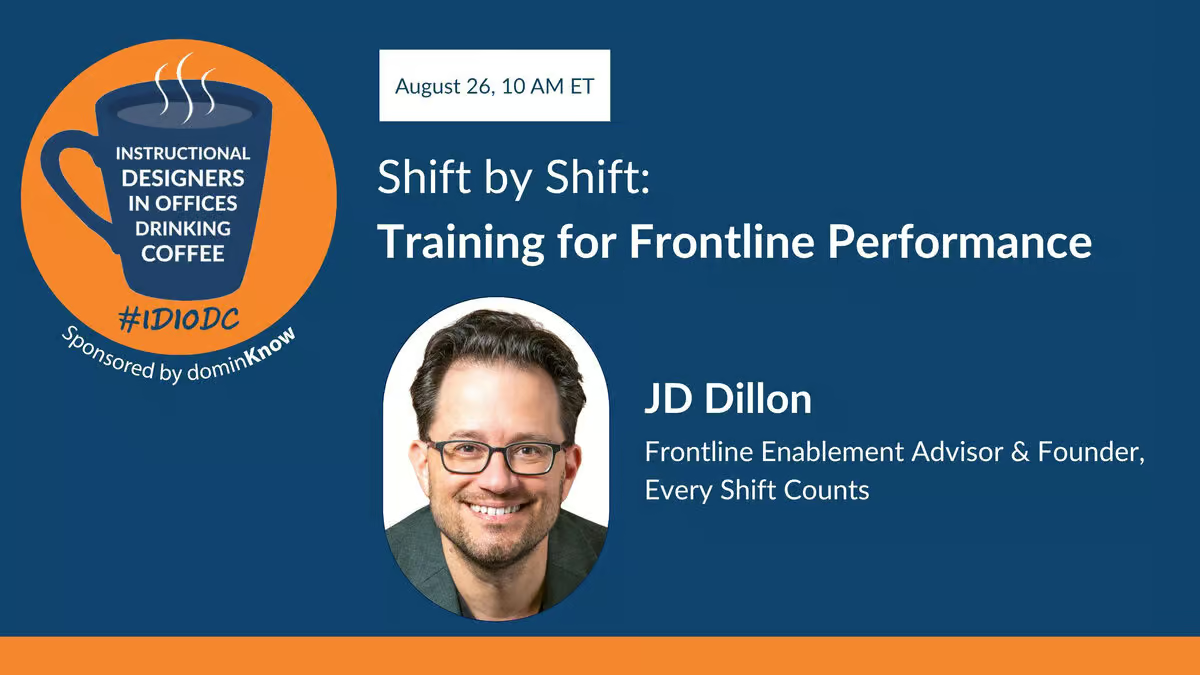
Welcome and Sponsor
Chris Van Wingerden: Welcome to Instructional Designers In Offices Drinking Coffee. Drinking hot beverages of choice, cold beverages, depending upon your geography, however you want to start your time with us. As always, every episode of Instructional Designers In Offices Drinking Coffee is brought to you by the team here at dominKnow, makers of dominKnow ONE, helping L&D teams develop, scale, and deliver learning that maximizes employee value.
Meet JD Dillon
Chris Van Wingerden: This week, folks, we have a brand new guest. JD Dillon is with us. He's not been here before. JD, introduce yourself to the folks who might be listening, watching.
JD Dillon: I'm JD.
Chris Van Wingerden: Perfect. That's all we needed to know.
JD Dillon: All right. If you don't know, are you paying attention? But no, great to be here. Thanks for the opportunity. Long story short, I'm a movie theater manager/theme park manager turned L&D professional, turned technologist, turned author and speaker who has a second book that came out in May, and my focus is frontline and deskless workers.
Chris Van Wingerden: Awesome, and that's quite a journey to have started. Very few folks sat at the tables in high school career development and said, "Oh, instructional designer. Oh, L&D training. Those all sound like careers I'm gonna go to." So many of us come into this from a side door or a different place and then slide in. Show us your book. First off, nice work. We've had chair dancing before, but I've never seen book dancing on an episode. But The Frontline Enablement Playbook.
Who Are Frontline Workers
Chris Van Wingerden: Let's start with the word frontline. Let's define that for folks in case there's some confusion.
JD Dillon: The frontline represents 80% of the working world, about 2.7 billion people that we rely on every day, not just for business success, but to drive our communities forward. It's the people that you run into, regardless of what you do professionally. When you go to a retail store, the grocery store, a hospital, a hotel, a manufacturing facility, a logistics facility, the person delivering the package to your front door right now. All of those folks represent the frontline and deskless workforce.
Chris Van Wingerden: That covers an awful lot of things. Let's flip the obverse. Who's not covered by frontline?
JD Dillon: You and me.
Chris Van Wingerden: Yeah, there we go. It's us.
JD Dillon: The corporate team. So, generally the people who are... it's a little less cut and dry because if you look at the term deskless, that's the term a lot of people either are familiar with or more easily connect with. But there are frontline workers who do work in front of screens, contact center agents, or a front desk clerk and these types of folks. I supported contact centers for six years as part of my journey, as my entire career has been wrapped around either being a member of, being management, or supporting frontline and deskless teams. So the deskless workforce is a huge chunk of this workforce, but there are a lot of people who work in a frontline capacity and share common attributes to deskless workers, but they do a job that looks more like this. They could be remote workers, but in a lot of cases aren't. On the other side, you have the support center, the corporate team, the marketing function, product function, development, senior management, the people who work in headquarters, maybe working in a remote capacity. Smaller numbers usually in this workforce, easier to wrap your arms around. They do a lot of different things under a lot of different banners, but there's a meaningful difference in how the job gets done on the corporate side as compared to the frontline side. If you're trying to help an organization be successful and help people be successful, you have to understand and lean into those differences, because there's just a frank reality that corporate strategy does not work when it comes to enabling frontline teams.
Chris Van Wingerden: Yeah.
Frontline vs Corporate Reality
Chris Van Wingerden: Let's talk about some of those differences since you brought it up.
JD Dillon: Let's talk about time. Everyone's busy, no one has time. But when you work in a corporate job, generally speaking, if you have a doctor's appointment at 12:00, you can find your way to that. You often work in a salaried role, so maybe you'll make up the hours later in the day, or work some on the weekend. That's not an option for people who work in an hourly frontline capacity. We can also talk about autonomy. Once you clock in for your shift, you don't get to decide, in most cases, what you're going to do with that time. You're assigned tasks. You spend a lot of time either working directly with customers or directly with the products and services of the business, and you have to ask permission for everything. So there is no world where a frontline worker can say, "I'm going to log into a learning management system and do some extra training today." No, because you're already understaffed as an operation, so if a person steps away from the line or the counter, the business doesn't work anymore. You start to lose money, customers start to get upset, and your peer group has to pick up the slack because you are not there. We're also talking about a wide diversity of individuals doing the same job. In a corporate environment, you have people at different points in their journey professionally, but usually you're working with people hired in for a specific job. They went to school for marketing, and now they've had some marketing jobs, so you hire them to be a product marketer. Right now, in a retail store somewhere, there are two people in onboarding today. One has been in retail for 25 years and has worked at this company twice before. They're sitting right next to a 16-year-old who's never had a job. So that person has to learn how to work, let alone how to work here, next to a person at a completely different point. As a support team, an enablement team, learning and development, HR, or operations, we have to figure out how to help both of those people do their best possible work, because they're going to face off against the same operational requirements, the same processes, the same products, the same compliance, and the same customers. Customers don't really care how long you've worked here or what your past experience is. They're here because you have a brand, a promise, you sell products, and this person is meant to support them through that. There's a unique nature to how the job is done, and traditional tactics around training, communication, and support often simply don't work because that's just not how people do the job. A lot of people who support these jobs come from these spaces. I never took a class in learning and development or corporate communications. I came in as a frontline employee, became frontline management, and then had the right skillset at the right time to make the transition into learning and development, so I'm versed in the operations side of things. But it's easy to lose connection to what the job is like, to focus and silo into what you find important and what your stakeholders are asking for, and to lose connection with what it's really like to do this job every day and how you can fit into their world, because they're not coming to you, they just can't. So it's understanding the persona of frontline work and the workflow. Those are more important strategic factors in how we enable performance than anything we talk about in learning and development principles.
Chris Van Wingerden: Yeah. I don't think I've ever actually been in a busy retail environment and noticed a number of cash registers not open and lines backing up, and thought, oh, all the other staff must be off taking their safety training or annual certifications in the LMS. It's always been more of a, "They don't have enough folks in today," kind of perspective. So we experience it on our side as customers, even if we aren't the ones doing that kind of work ourselves.
Enablement Not Training
Chris Van Wingerden: The title of your book has the word enablement rather than training. Let's talk about that a little bit.
JD Dillon: Training is just part of the story. I use enablement as an umbrella term because it's everything I can do to help an individual be successful in their shift every day, so they can drive the outcomes the location and management team are looking for, in order to drive the outcomes the business is looking to achieve. It is never about learning. No one comes to the job every day to learn. They come to do, right? They're here to do a job, for different reasons. Another mistake we often make is assuming every frontline worker joins your company because they want to build a career in this industry. They don't. Some do, and some of those people end up being the ones making the decisions.
Chris Van Wingerden: Mm.
JD Dillon: Right. They kind of found the path. You were a good frontline employee, they turned you into a manager, and then you got an opportunity to work in the corporate team, and now you're trying to chart that path for everybody else, when the vast majority of people don't want that path, and the math doesn't work in their favor. If you have 10,000 frontline workers and 600 corporate employees, the math doesn't math in that situation. So it has to be about everything we can do to help a person do their job effectively, because training is critically important, but so is making sure people have access to information so they can solve a problem or answer a question. So is thinking about recognition and motivation and appreciating the work people are doing every day. So is what it takes to empower managers, because managers are the most important people in the workplace, especially in a frontline workplace. Frontline employees don't work for your company, they work for their manager, the person who hired them, trained them, coaches them, pays them, schedules them, and knows their name. So enablement is a bigger story about everything we collectively can do to help people be successful and, as a result, help the organization be successful, and that's true for people in HR, learning and development, communications, knowledge management, and operations. Especially at a smaller or mid-market business, a lot of times that's one or two people, or a very small team, trying to support hundreds of thousands of people distributed across dozens to hundreds of locations. If we think about it from a programmatic or content-centric perspective, it just falls flat, because I can't pull people out of the operation, we already don't have enough labor hours. When I was a frontline manager, I didn't have the greatest opinion of corporate L&D, because more often than not, they either weren't providing the support I needed, or they got in my way with a training requirement I didn't understand or wasn't clued into, that took hours away from me and made it harder to hit my number that day or that hour. So it's about rethinking the relationship we have with frontline operations and pulling every tool we have out of the bag to make a person feel not just capable, but confident that they can succeed today. Even if they don't want to build a career here, the vast majority of people doing this work want to be safe. They don't want to get hurt or get yelled at today, and they want to feel good about what they're doing and be successful, because they want their team to be successful.
Chris Van Wingerden: Yeah.
Turnover and Quick Quits
Chris Van Wingerden: It's a space with huge turnover too. If you have folks who maybe don't want a career, but at least don't hate coming in, for a variety of reasons, you can reduce turnover, and that's a huge operational cost saving from that perspective.
JD Dillon: Turnover in most frontline spaces, though it's important to acknowledge frontline isn't one thing. If we're talking about nurses who went to school for years for this type of job versus a 16-year-old bagging groceries, that's a very different reality, but there are commonalities in how the job is done. Turnover is baked into the business model. Most organizations don't want to eliminate 100% of their turnover, it's part of the strategy. What you do want, generally, is to increase tenure. If you can hold people for an additional 90 days, you can make sure people don't walk out on the first shift. Quick quits are a unique frontline challenge, because a lot of people who get a corporate job, who spent months pursuing it, maybe relocated, went through six rounds of interviews, are usually going to stick it out for a period of time to figure out if it works for them. Frontline employees, if it doesn't work by the first break on their first day, they just walk out, because there might be a comparable job down the street that maybe even pays better. It's not about reducing costs on the business, because I've never seen a company make a decision based on how much it costs to replace a frontline worker. I have seen them make decisions about how much it costs to replace a frontline manager, because that's a very different position with a very different level of accountability and disruption if they're removed from the business. But for frontline workers, it's more about disruption to the operation. It's not the cost of replacing a person, it's what happens if that becomes a constant revolving door, and at what point it goes from strategic turnover to, "We can't execute anymore, we can't deliver." That impact shows up in the spreadsheet, on sales, on customer feedback and loyalty, and it limits our ability to move at the pace the business requires. So even turnover and retention require thinking about it from an operational impact perspective, less from a human resources perspective.
Chris Van Wingerden: What are some of the worst things you've seen done in this space? Give us a perspective before we get into what people could be doing successfully.
JD Dillon: Have you ever seen a whole store quit?
Chris Van Wingerden: I haven't, but I'm sensing you might have a story.
Writing the Frontline Book
JD Dillon: It was important for me. If you break my career in half, the first half is spent deeply embedded inside frontline operations: movie theaters, theme parks, contact center operations. Every day I was inside that environment. The second half, I'm in technology, still supporting and building tools for frontline teams, and then speaking, writing, and being more on the strategic and advisory side of the conversation. So when I went to write a book about what we can do to support frontline workers, and this is unfortunately the first book about what it takes to support frontline workers, because we just don't talk about them very much despite our reliance on them and the scale of the audience, it was important for me to come across authentically, and not be a guy who's been a remote employee for the past 10-plus years telling people who do this physically and emotionally demanding work, "Here's what you should be doing," or telling the people who support them, "Here's what you're doing wrong." Absolutely not. So as part of writing the book, first I had to go find people who are doing the work today. There are 50 other contributing authors in this book, and hundreds of other people's voices are echoed based on conversations and interviews I completed. A lot of people couldn't contribute, either because they didn't have time supporting a large distributed frontline team, or their legal department wouldn't let them share things, but they had perspectives that could inform the story. Second, my favorite part of this book are 12 specific entries from frontline workers and managers on the ground today, talking about what they find important, what they need to be successful, how they feel about this work, and why they do the job. Those letters ground the story in reality. Then I went a step further. Most of this book, at least the 70% or so I wrote, is written in frontline spaces. I sat in cafes, coffee shops, hotel lobbies, and spent a day in a theme park writing. I wrote the book about frontline workers on the frontline, and quickly realized this was actually an educational experience, clicking back into place things I hadn't thought about for a long time. I share a lot of stories of my own, mostly from my time as a frontline manager, not necessarily as an L&D professional. One chapter starts on New Year's Eve, sitting in a booth in a restaurant, watching a restaurant manager not get her job done for four and a half hours, because every time she sat back down to build the staff schedule, something happened: someone called her name in the kitchen, an off-shift employee came in with a question, an upset customer needed her. She didn't know I was writing down her story, and I used it to say, "I remember that day," or "I remember what that was like." It was critically important for me to ground the story in reality while providing enough perspective and proven practices to help people break out of the day-to-day bubble. As a corporate practitioner, it's easy to think, "Here's how we do it here," and not realize there are people out there struggling with the same challenge, finding ways to overcome it, but it's hard to reach them, even with so much content on the internet. When you go to conferences and read articles in the people-practice space, you don't see this audience. If you were a frontline retail associate and are now in charge of retail training at the support center, it's hard to see yourself in the stories told in the industry, because those conversations don't feature the challenges of this space. Even generalized sessions, like one on instructional design, often don't take into account what this audience has to deal with. I think a lot of that comes down to people not having this experience, or not having thought about it much. What's interesting is when I talk about this, people click on and realize, "I worked in a restaurant when I was 19, and it never occurred to me that what you're describing now doesn't take my experience into account." Or in a technology session, the first hand that goes up says, "I work in a highly regulated industry, my people don't have devices, how does this work for me?" So all of us, regardless of the business or audience we support, can take into account that different people do their jobs differently. It's a very large number of people who need help, and we can include them more effectively in everything we talk about. Instead of just talking about remote work as the future of work, we could include the idea of flexibility for someone who has to be on site, like a construction worker who can't work remotely. What does flexibility mean to them? It's still important, because they still have a life, kids, and appointments. How do we bake flexibility into everything, instead of only defining it the way people who do a certain type of work in a certain setting define it?
Chris Van Wingerden: I was just reflecting. I've done retail, back when I was 18, 19, 20. Thinking about those experiences, it was a mixture of working at a large national retailer here in Canada in high school.
JD Dillon: Mm.
Chris Van Wingerden: And folks watching anything visual will recognize the color of my hair reflects the distance between then and now. Reflecting back, there wasn't much at that point, maybe a couple of bits of paperwork at the start, and then you were shown what to do by the person beside you. Once in a while a manager would walk you through some basics, but a lot of it was learning by osmosis, picking up the good habits and potentially the poor habits of whoever happened to be explaining that part of the job. There was a lack of standardization at that time.
Going Glocal Training Systems
Chris Van Wingerden: How do teams start addressing that?
JD Dillon: The key is in the location. You can't control day-to-day operations from a corporate office where you don't see it and don't understand it. The SOP does not reflect reality. Frontline work is messy and unpredictable. As a manager, using my movie theater experience as an example, I'd walk into the day with a plan, and then three people call out sick, the truck is late, and we lose power in half the building. It's really hard to build a predictable system from outside the system itself. For me, it's a balancing act. I call it Going Glocal in the book: what systems and tools can we provide from a corporate or support center perspective, and how do we enable the people on site to activate those tools and shape the experience in a way that's most meaningful to them? Take learning and development as an example. Sometime around the mid-2000s, we decided learning and development was a digital concept, so much of what we talk about is digital content, an Articulate module, a video. That ignores the fact that especially in frontline work, the vast majority of learning takes place shoulder to shoulder with a peer or manager. When's the last time you went to a webinar about hands-on job training practices?
Chris Van Wingerden: Mm.
JD Dillon: We've forgotten that's the biggest part of what we do, because in a corporate office you don't do a lot of that from a structured perspective, maybe you poke the person in the next cubicle once in a while, but you don't have the same journey people in frontline spaces do. So it comes down to leaning into the fact that every location is different. You can walk into two different grocery stores on the same street, owned by the same company, and they feel different, even though the products, layout, and uniforms are the same. What's different is the person who manages the business and the people who work there. So how do you provide the labor hours, the tools, the access to information, the elements that fit how the job gets done, and then activate the trainers in that location? You need to make sure the manager has permission to lead: the time, the accountability, the training, and the resources to do what they need to do, because they set the tone and drive the culture in that location. It's less about trying to do the same thing everywhere, because you can't, the people are different and you can't see them. When you try to force it, the location manager, who has numbers to hit, overrides whatever your plan was, bulldozes your scoped-out curriculum on day one, checks all the boxes, and throws the person out on the job unprepared. We need to understand the reality of the job, what it takes to support that, and then activate the people in the locations. The best businesses hold managers accountable, make sure they have the right tools, and shape a strong location trainer system. If the local training is just whoever happens to be there that day showing someone how it works, you have a mess. At Disney, they really lean into location trainers. Among my name tags is my trainer pin from when I was a trainer there, and they're really good at building that sense of accountability. As a cast member, I didn't feel accountable in my day-to-day performance to The Walt Disney Company, that felt far away. I felt accountable to a guy named Marcus, because Marcus trained me. He spent five days making sure I was good, we worked alongside one another, and he'd let me know if I wasn't doing things the way he trained me. And I was also accountable to a guy named Michael, because Michael trained Marcus. We had this tight-knit sense of ownership over how the job was done within the team itself, the people who did the job, not the corporate L&D team I never saw. If I wasn't hitting the mark, it wasn't just my manager who talked to me, it was Marcus and it was Michael. That's building a shared system of accountability, because that's what frontline teams are. The best frontline teams have this shared sense of connection and hold one another accountable in a way the corporate team just can't. When you hit a corporate goal, how often does the frontline team meaningfully celebrate it? But when you get through a messy day and the people on site are tired but feel like they did it, that's what success looks like, and it's that sense of shared success and shared accountability that helps you overcome the distributed, dynamic nature of supporting a frontline workforce.
Chris Van Wingerden: Yeah, and I'm sure a lot of us who've done this kind of work have experienced both ends of that extreme, the camaraderie and connectedness that contributes to a positive outcome, versus the stuff-runs-downhill kind of experience.
Empathy and Manager Support
Chris Van Wingerden: It feels like a lot of this depends on the nature of the people in these roles. It's chaotic, but at the root of it, you've got to have empathy to support people and move them forward. Is that a factor in how organizations look at these training and management roles?
JD Dillon: Empathy is a magic word. This book is 650 pages, it's not a light read, because if we're going to cover a story this dynamic and significant, we need to do it as comprehensively as we can in one book. There's an entire section dedicated to the manager, and I talk about the fact that the most important skill for frontline managers is empathy, understanding what people are going through and what it takes to help them do their best every day. I had to learn that through experience, because I started in management as a 20-year-old. I didn't know anything, especially about life, and some of my team members were in their 30s, 40s, and 50s, with kids and responsibilities I had no understanding of. I had to learn that a conversation about performance, attendance, or personal hygiene wasn't as simple as the SOP outlined it to be. Why can't you get to work on time? Transportation issues. Why do you have transportation issues? The car is breaking down and you can't afford to fix it. How do I actually help you solve the problem, instead of just holding you accountable for the outcome? I didn't learn this from a classroom, I never completed a management training program, because in a lot of cases people couldn't pull me from the operation to send me to classes. I learned what empathy was from a woman named Kathy, an epic frontline manager. I got lucky and worked alongside her for a summer, and saw what it was like to lead based on relationships rather than title. That's what taught me how to motivate people and create a sense of connection and community. But empathy is multi-directional, not just about managers. It's baked into leadership development programs that managers should demonstrate empathy for their teams, but how do we demonstrate empathy for the people doing this job when we work with stakeholders and subject matter experts, making sure they understand what the management team deals with every day when we roll out new training, a new campaign, or a new product? How do we bake empathy into our own workflow and strategy? And how do we make sure frontline team members demonstrate empathy toward their own management team, understanding that the frontline manager sits in the middle seat of the workplace, with corporate demands on one side and customers and team members on the other? How often do they get a chance to focus on their own development and make decisions that feel right for their own career? There's an us-versus-them dynamic in a lot of frontline workplaces, and the manager gets trapped in it, responsible for executing decisions they didn't make, without knowing how, because they only know what's been told to them. The employee looks at the manager, not past them to the corporate team, and relies on the manager to communicate the why, what, when, and where. How do we make sure employees understand the manager's job and that it's a difficult position? Some of my favorite moments as a frontline manager were getting through a difficult situation as a team, and someone saying, "That's why you get paid the big bucks." I knew I didn't get paid the big bucks, but it was their way of saying, "I see what you deal with, I'm glad I'm not you, this is why we have you, because you're able to do the things I don't want to or can't do." That was a demonstration of empathy and understanding that made it less about manager versus employee and more about team, connection, and community. Empathy is the most important capability in the frontline space, and community and connection are the unlocks to frontline performance and outcomes we often don't talk about, especially from an L&D perspective.
Chris Van Wingerden: We might often think of those as intangibles, not something measured by a clock or numeric values, but the fundamental thing that connects everything behind the scenes.
Performance and Enablement Ecosystems
Chris Van Wingerden: Let's talk about tracking performance. My job performance measurements are a lot different than someone in a call center, and some of those performances are fairly specific and focused. What are some of the best things people can do to enable folks to meet their performance requirements?
JD Dillon: Frontline work, generally speaking, is infinitely more measurable than corporate work.
Chris Van Wingerden: Mm.
JD Dillon: Right. Everyone in the corporate environment has a different goal, and you spend three to four months at the start of the year trying to define individual goals and somehow stitch them to corporate goals they have little to no meaningful impact on. But in the frontline space, I can tell you exactly how most of these jobs are measured: productivity, sales, customer satisfaction, number of credit cards signed up, items scanned per minute. The data is there. Contact centers are the best example, they're data factories. We know exactly what people are doing, we've been measuring sentiment in conversations using AI for a decade. The ability to connect the dots between intervention, solution, and outcome is pretty clear-cut. It's not about measuring outcome, it's about measuring iterative change to outcome, that's how you go from correlation to causation when measuring the impact of anything affecting performance. But how do you help people do this job more effectively? For me, the biggest shift, especially from an L&D perspective, is moving away from a programmatic or content-based approach, where every stakeholder request or compliance requirement means building a new thing, and the employee on the other side, who doesn't have time today, is left wondering what you're doing to them today. If you have to include instructions at the start of your e-learning module on how to use the module, or the second slide says, "In this module you will learn," you're already heading down the wrong path. So it's going from programs to systems: how do you scaffold the job with an always-on enablement ecosystem people can lean on as they're first learning the job, or to absorb change? That's one of the biggest challenges facing teams that support frontline workers, the pace of change, especially in an industry like financial services with new products, processes, and regulations all the time. When do you possibly think about skill development when you're just trying to keep the machinery moving? Instead of building and delivering a program, it's about how we make information more readily available, giving people crutches they can lean on to find answers when and where they need them, because we know they're not going to retain all the critical information. How do we separate the things people need to know from the things they can look up on the job? How do we give people a chance to practice and reinforce? If you have three minutes in a shift to deliver some type of training, how do you maximize those three minutes so people remember the right things on the job? And how do we scaffold our way up to the structured side of training, because that doesn't go away? Classrooms are still critically important in frontline workspaces, hands-on job training is essential, it's the most important training tactic available, because you don't learn to weld on the internet. But those more disruptive tools usually require double the labor hours, because you need the trainee and the trainer, and there's no way that's not disrupting a minimally staffed operation, which is why labor hours are the most important resource in frontline learning and development. So we only deploy the structured side of training when we absolutely need to, because of complexity or compliance requirements, and we leverage the tools and systems around people to support and scaffold the work: access to information, AI to make information easier to move around the organization, coaches and managers present and physically observing people doing the job and providing feedback in the moment. That system ultimately helps people feel more capable and confident on the job every shift. Then we can plug in digital content when it's the right thing, or a hands-on experience when we have to pull someone from the operation or add a trainer, or put a group into a classroom because that's the right environment. How often, when supporting corporate team members, do you calculate how expensive a training class is? You just don't think that way, you deploy it, put it in the learning management system, and it gets completed as a task. Flip to a frontline environment: if you deploy a 30-minute e-learning module required of every employee, you have to do the math. What's the average wage, the number of employees, the number of hours required? It's not just the time to complete the training, do you have to add 15 minutes on either side to move people to where the devices are and back to where they do the job? How much does that actually cost, tens or hundreds of thousands of dollars, to deploy? That's how the operations team is thinking about this conversation before they get anywhere near what this actually helps them achieve. So it's rethinking not just the strategy, tools, and tactics, but the overall conversation, because no one in that workplace cares about learning. They care about having a capable, confident team, because from the manager to the frontline team member, these are the people they're relying on to execute whatever comes next. If you walk through the door talking about learning and skill development instead of how the team will execute more effectively and productively to drive an outcome the business cares about, you're missing the operational conversation. It's the perspective we bring to what we do when facing this part of the workforce.
Real World Orientation Examples
Chris Van Wingerden: I think of how privileged we often are in our space, thinking about the ADDIE model and those structures that formulate how we put things together. I can picture it being deployed and going right out the window because it doesn't fit the reality of the actual workspace and the allotted time. I remember someone sharing how they were grabbing coffee at a major chain restaurant and observed two team members in the corner flipping through a binder of printed PowerPoint slides, one telling the other about each slide, a training moment. It's so distant from what even those of us privileged enough to build things for the LMS are used to.
JD Dillon: I don't know how many people actually sit back and say, "I'm privileged to put things in a learning management system."
Chris Van Wingerden: Fair enough, but still.
JD Dillon: If I have to do heads-down work, I struggle doing it at home, so I go out, like I did when I wrote the book. There's one particular restaurant I sit in on a regular basis, to the point where I'm waiting for someone to ask what I do, because I'm there so regularly. Once every couple of weeks I see an orientation take place. What does it look like? This restaurant has no back-of-house space, no office, no training room. It's the place where I watch the manager sit in a booth, constantly disrupted, unable to do their own job. I watch the orientation session: the manager sitting at a set of connected tables with four or five new employees and a literal flip chart, flipping to a new sheet of paper and talking through the topic. No PowerPoint, no screen, no projector. That happens now. What surprised me writing the book, trying to stay connected to what it's like to do these jobs today, was how little I was surprised. Talking to people managing construction sites, manufacturing facilities, restaurants, or hotels, it all felt similar. Some of the tools have changed, self-service technology, curbside pickup, self-checkout, but the work itself is still really similar. That's why it's interesting to think about the frontline and the future of work, automation, AI, and job displacement: the corporate team right now is having an experience the frontline team has been having for the last 25 to 30 years. The frontline team understands where their value is, how they contribute, and how they're impacted by automation and technology, very differently than the current conversation in the rest of the workplace. Learning is not a digital concept. Right now, a hotel is putting a housekeeping team, people who speak different languages, in a room, because this is the best way to communicate this information given they don't have enough screens in the workplace to deploy it digitally, and everyone signs a piece of paper on the way out to confirm they consumed the information. The most expeditious way to do this is the old-school way. As an enablement team, we have to embrace that reality and ask, how do we work within how things get done, rather than trying to completely change the operation? I worked with a grocery store owner who told me, "I'm not changing how I run my business for you. I need spandex, not concrete." I need to fit into his reality, because he's not changing his day-to-day operation for me. That's the key to the story in The Frontline Enablement Playbook: how do we take what we learn across these industries and create a strategy that fits how the job gets done, so we can elevate frontline performance and, in doing so, elevate the business? It's not just about what people deserve, everyone deserves a chance to do their best and feel capable and confident on the job, but to get there, we have to elevate the operation and the outcomes. That's the story I tell in the book, and what I'm trying to help organizations achieve in their frontline strategies.
Wrap Up and Where to Find JD
Chris Van Wingerden: That's probably a great place for us to wrap up for today. For anybody listening to the audio podcast, they can find more information about the book at jddillon.com/frontlinebook, all one word.
JD Dillon: If you like fun URLs, my first book, The Modern Learning Ecosystem, is available at jdwroteabook.com, which means if you go to jdwroteanotherbook.com, it will take you to The Frontline Enablement Playbook as well.
Chris Van Wingerden: Right.
JD Dillon: Do I own jdwroteathirdbook.com? To be determined.
Chris Van Wingerden: Not a bad investment, parking a URL for a bit just to see. Really cheap, surprisingly, just to see what might come, and you'd be resentful if you'd lost the opportunity to have that URL.
JD Dillon: There's a particular company in this business that caused that to happen, because I tried to get things like modernlearningecosystem.com and whatnot. Once I couldn't get anything related to the book, I figured, let's go fun: JD Wrote a Book. Every time I say it, people think it's funny, and I have to remind them that's the real one, the book is available at JD Wrote a Book, so jdwroteanotherbook.com.
Chris Van Wingerden: JD, what an awesome conversation. You're absolutely right, it's a space that doesn't get covered a lot. Reflecting on seven or eight years of doing IDIODC, I don't know that we've had a session previously that's even reflected this, let alone focused on it sufficiently. Glad to have you with us. Folks, don't forget, Instructional Designers In Offices Drinking Coffee is brought to you by the team here at dominKnow, makers of dominKnow ONE, helping L&D teams develop, scale, and deliver learning that maximizes employee value. Check us out at dominknow.com. It's time to dance on out. JD, thanks for a great time, I really appreciated the conversation.
JD Dillon: Thanks so much, Chris.



.svg)

.svg)