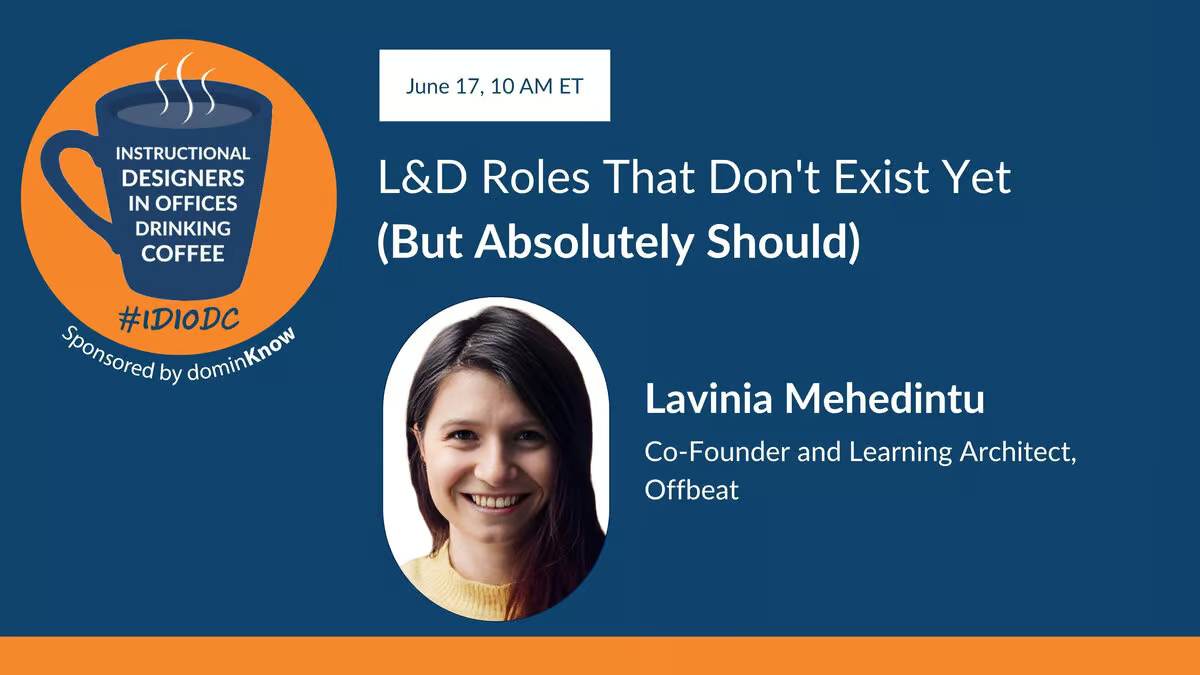
Meet Lavinia Mehedintu
Chris Van Wingerden: Hey folks, hope your days are going well so far. Lavinia Mehedintu is joining us here today. Tell us a little bit about yourself since it's your first time joining us here on Instructional Designers in Offices Drinking Coffee.
Lavinia Mehedintu: Hello, everyone, wherever you are in the world. I am Lavinia. I'm calling from Bucharest, Romania. I have a background in HR and L&D, and right now I'm running Offbeat, which is a space where L&D professionals come to share their experiences, share their knowledge, and also discuss their challenges and the future of L&D. So this is what I do all day.
What's Changing in L&D
Chris Van Wingerden: You folks have been digging into this world that we work in, in our learning and development spaces, whether we're instructional designers or content makers. That's what we're here to talk about today. There's a lot of change happening, a lot of new stuff, whether it's AI or other things poking their heads into our worlds and saying, "Hey, we're here. What are you gonna do about it?" So let's talk about some of the things that you've been hearing lately from folks.
Lavinia Mehedintu: Oh, so many things. There are some things that have been recurring over the years ever since we started Offbeat, and also some new things. AI is a big topic for everyone at the moment from multiple angles. It is about how we are adopting AI as L&Ds. It's also about how we're supporting AI enablement in our companies for everyone else to use AI in an effective, sustainable way. And it's also about the fact that AI is changing some learning habits that people have when it comes to consuming content, maybe even a bit about how they think about coaching. So there are many angles when it comes to AI. These are the new bits and pieces, but I would say the old topics still poke their head out here and there, like measurement in L&D, behavior change, how do we properly support it? The fact that we need to do more than training. We need to think more systemically. So all these things are not new, but are still very important regardless of the AI conversation.
AI Reactions and Overwhelm
Chris Van Wingerden: What kind of reactions are you finding to AI? I'm going to bet that it's probably not 100% the same for everyone.
Lavinia Mehedintu: You would win some money for that bet. It's a very wide range of reactions. We have people who are extremely worried about the job market in general, about their roles, about sustainability, and so on. And then we have a bunch of people who are crazy about AI, who are experimenting every day in their roles but even outside their organizational boundaries trying to figure out how to use AI. So we have everything in between as well, quite a few diverse reactions.
Chris Van Wingerden: We've had our client teams talking about it in different ways for more than a few years now. Some of the client teams are very, very cautious, and very understandably so because they work in secure things that they need to keep under wraps. There's a lot of concern about the security of these types of tools. Many of them have a very cautious approach. And then some of those organizations are ready to roll up their sleeves and get into it. It's really been interesting to see how even organizations in the same vertical space can have different reactions. And then within those organizations, you might have people who are very cautious but who mention that they've been doing stuff themselves just to stay on top of it, learning and understanding it, maybe looking to be ready for it when it can come into their organization.
Lavinia Mehedintu: That's such an interesting point because what I do hear across the board is how overwhelming staying on top of everything is. There's so much noise. The question is always, how can I make sure that I do the maximum effort but with the minimum energy that I have available? Because people have so many things on their plates at the moment. If they want to keep themselves up to date, how can they do so in the most effective way? And I would say that this is true for L&D, but it's true across the board for product engineering and everyone. So that's definitely a challenge that comes up at any stage.
Do We Still Need IDs
Chris Van Wingerden: One of the things that I think about, and it's reflected in what I've read in some circles, is if we have an amazing set of tools now with AI, do people even need to learn? Does the next generation even need someone to learn something called instructional design anymore? What are you hearing around that?
Lavinia Mehedintu: Oh, so many opinions. I think the general agreement in the community is that yes, there is a need for a role that takes care of learning, maybe not the role that we've had so far. Just the fact that we have access to these tools and to content and even to personalized learning doesn't guarantee that people will also use the knowledge from AI. So the question is: How can we make sure that we look at things more systemically, that we look at the blockers that organizations have when it comes to learning? By asking what's blocking people in this organization to learn, we learn that it's not just access to content or AI. There are so many other things, like psychological safety or the way knowledge flows in the company. So one part of our role will be to look at those blockers.
Lavinia Mehedintu: But when we say if we have all these AI tools is this role still needed, we assume that human-to-human interaction will no longer be needed. What we're already doing when we bring people into training sessions, traditionally we've been focusing quite a lot on content and less on connecting people in a training session. But I think that's where the beauty lies of an L&D role: facilitating those conversations and helping people make sense together of change or anything else that's on their plate. So our role in those cases and traditional training will matter less, and helping people connect will matter even more. When content is abundant and technology is abundant, I don't think the value of human interaction will be lower. I think it will be higher.
Curation Beyond Content
Chris Van Wingerden: We used to talk about topics that come up and last for a brief period at conferences and then something else new and shiny comes along. AI seems to be more persistent. But there was a phase where one of the topics was the role of L&D not just in making content but the curatorial role of gathering things together. It almost sounds to me like maybe what you're describing is that that might start to become including curating people, in other words connecting people, as opposed to the content. Is that kind of what you're hearing?
Lavinia Mehedintu: Yes, exactly. We've been discussing so much in our community what curation means. I feel like it's been attached to content quite a lot, so we've thought that curation is only related to content. But to your point, I think it can be about people. It can be about opportunities as well, making sure that people see the projects they have available in their company and connecting people to those projects. So yeah, I totally agree. I don't think it's just about content, but I still think curation is important. The curation of experiences. It can be a broader term than it is at the moment.
From AI Experiments to Process
Chris Van Wingerden: Anything else that you're hearing around the AI stuff that we haven't talked about yet?
Lavinia Mehedintu: I think what's interesting is that quite a few people in L&D, but broader, have been experimenting quite a lot with AI but haven't had the opportunity or the option just yet to integrate AI into their day-to-day work. It's one thing to just experiment randomly with AI. It's another thing to look at your processes, ask where does AI fit in, how much should an AI do in different steps of a particular process, when should the human intervene, and so on. So the discussion that we've been having just recently is, as L&D professionals, how do we make sure that we move from experimentation to process integration when it comes to AI? Because that's where the impact also lies. Otherwise it's just spending money on AI, which we're recently learning is more costly than we initially believed, without actually seeing that ROI within our teams or in businesses overall.
Behavior Change Over Content
Chris Van Wingerden: AI sure makes things faster to complete. You can use certain tools and generate more content more quickly. But it's also been reflected that that isn't necessarily a helpful thing. We've got a long history in our own space of making lots of things that give people potentially information, but not knowing whether these are actually ultimately helping an organization with the changes that it might need. Are people actually taking something that we've given them and actually applying it on the job, or is it just being consumed so that the check mark can go in the LMS? If you have a lot more stuff coming at people, being made faster and pushed out faster, it feels maybe there's also a risk of even increasing that and ultimately maybe having less actual impact on the things that we're supposed to be doing, which are changing behavior so that people improve things. Are you hearing much around that front?
Lavinia Mehedintu: A lot. Quite a lot. I think initially, just like you mentioned, one of the first use cases where AI has been used was content creation, and everybody was so happy that we can create content faster. And then very, very quickly we went back and started asking, "Is that enough?" Because there's an implied assumption there that if we create more content people will change their behaviors faster or more people will change their behaviors. But if we look back at the research, there are so many conditions that need to be in place for behaviors to actually change. Even traditionally our training sessions and e-learnings were mostly solutions for a few of those conditions. Maybe for people to be aware that there is such a behavior and that that behavior can benefit them, or to have some resources like a framework. But then in the flow of work, people need reminders. They need incentives to change their behavior. They need so many other things. And it comes back to that systemic thinking and looking at the behavioral blockers in the organization or in your team, and for L&D to act on those as well.
Lavinia Mehedintu: Another conversation we've been having is that AI can enable and help us with automating some of the processes that we've been doing so far manually, so it unlocks time for us to take care of these other things and come up with new solutions to the blockers that we see in the organization. I think there's some truth to it. We were over-optimistic with how quickly AI will help us deliver on that promise. But yes, there is a case to be made for expanding the L&D role beyond what we've been doing so far.
Becoming Business Partners
Chris Van Wingerden: But maybe working against that is the fact that we're often just seen as a service bureau. People hand us a bunch of stuff and they say, "Make a course, and get it out there." If we're going to change our role, there's some things that we need to think about in how we're going to change that role. And is it even possible to change our role and/or even the way that we're perceived by others in our role?
Lavinia Mehedintu: The optimist in me says yes, we can. It's very easy to generalize and say yes we can do it all across the board. I think there is an option in some organizations to do that. I'm not sure if it's in most organizations or not. I think there's a case for us to become business partners rather than L&D business partners, if that makes any sense. Just understanding the business way better, spending more time in conversations with stakeholders, talking about not what we do but what they do. Slowly, even with very small experiments and changes, getting closer to the business. So for sure, in theory it can be done. I'm seeing in our community people who in time got there. But of course it's not just our responsibility to become more business-oriented, it's also what the system allows us to do. In some cases the system is very hard to change. There's this saying in coaching that you can't coach the uncoachable. I guess for us in L&D and in instructional design, it's like you cannot offer consulting services to someone who just doesn't want your consulting services. So it depends case by case, but it's our responsibility to try and to experiment and to push those boundaries for the next generation at least.
Chris Van Wingerden: Circling back, if AI can do so many things, is there a next generation? One of the things in the programming world I've seen commenters observing is that if all of the junior programming roles are taken up by people using AI, then how do we ever achieve senior developers in the future? Maybe senior talent isn't needed in the future either. Who knows what it might hold.
Lavinia Mehedintu: I don't have an answer for this. What I did observe in practice is that even to interact with AI as it is right now, with whatever LLM you're using, you do need some sort of basic knowledge. You need to know what you don't know. You need to have a basic understanding of your field of work to actually have deep, thoughtful conversations with AI. It's a bit like social media unfortunately because the algorithm personalizes whatever content you get. It's very similar with AI because the questions you're going to ask, it's going to answer those questions. So there's a case to be made about critical thinking and making sure that you prompt the LLM in a certain way. But going further whether we're still needed, I think that's such a big conversation to be had by everyone, not just L&Ds.
Chris Van Wingerden: We're not unique in feeling this impact and this change. It is changing all kinds of other spaces and industries as well too.
Lavinia Mehedintu: It's very interesting. I was talking to my friends who are in engineering, and what many people don't realize is that for them, for example, it's the first time when something like this happens. Because over the past few decades, the need for engineers has only grown. And that's the problem with this: you have so many young people who have gone to these universities based on demand of work that's now slowing down or even dropping. So you have all of these junior people who are graduates who cannot maybe find work right now. So it is changing for literally everyone. Artists, everyone. If it's any consolation that we're not alone in this struggle, I don't know. Anyway, it's a tough concept if you are actually worrying about your job prospects.
Beyond AI: The OD Shift
Chris Van Wingerden: Let's swing away from AI then and talk about other things that you're hearing in your community, other things that are on people's minds.
Lavinia Mehedintu: Yes. It's interesting because it is related to everything we've been talking so far. If content is no longer our focus in these sessions that we bring people together, what is our focus? And how do we design sessions that people actually want to join, given we're seeing lower and lower engagement in traditional training? How do we design spaces where people can connect? So a lot of the conversations that we have in our community are about experience design, not to be confused with learning experience design. They're not two separate things, but experience design is the broader field. It is about behavior change. It is about facilitation. This is a skill. Talking about ways to job security and feeling a bit stressed about this in L&D at least, not necessarily in instructional design, but in L&D we do have the skills, this facilitation skill that we've been using so much in skill development workshops. I don't think, at least short term, we will see a decrease in need for facilitation. So we can put ourselves forward when it comes to that type of project. These are some of the conversations. Again, this idea of systemic thinking. L&D in general getting closer maybe to OD as a function and as a job description. It's something else that we are exploring quite a lot.
Chris Van Wingerden: And I think there's probably folks who are hearing that OD. What is OD?
Lavinia Mehedintu: Oh, sorry. It's organizational design. So basically, if so far we have been doing a very small part of organizational design, making sure or trying to make sure that people have the skills that they need to perform in their roles, OD takes a broader view. It looks at what are the processes that need to be in place for people to perform, what's the technology that needs to be in place, how are we designing incentives, formal and informal incentives, how do different people processes from HR, the people function, come together in order to have a cohesive narrative for an employee from end to end. So OD takes this broader role in order to make sure that the organization has the capabilities to perform. And again, we've been doing a very, very small part: delivering training, creating content, and so on. And as that maybe becomes automated or less needed, a way of looking at our future is what else is needed for people to perform, which has been traditionally answered by organizational design.
Chris Van Wingerden: And that would involve us moving outside of our silo and breaking down barriers, particularly the way that we're currently perceived.
Lavinia Mehedintu: Yeah, for sure.
Three Horizons of Change
Lavinia Mehedintu: There's no clear-cut way to get there if you ask me. Right now it feels like there's this theory of the three horizons. The first horizon is the status quo. The third horizon is an ideal that you have for the future that right now is very uncertain, unclear for everybody. And then there's this middle horizon, horizon two, that's very messy. And it can be noticed because many different people are experimenting in different ways with different things, and there's no clear pattern that you can follow in order to get from A to Z. And that can be stressing and confusing for many, many people. And of course you have a few ways to respond to that stress. You can either go back to your shell and be afraid and be worried, keep doing whatever you've been doing. Or you can just be an experimenter yourself and try things out, small things. You don't need to make big changes. And I think the future will require us to be more like that because what I wonder is whether we will ever go back to more stable times or if this velocity of change is something that we just need to get used to and adapt to.
Chris Van Wingerden: Change is the only constant, I think maybe that's it.
Which L&D Roles Survive
Chris Van Wingerden: We have a lot of roles currently in the learning and development space: instructional designer, facilitators, other sorts of roles. They're kind of all a Venn diagram. They've all got some overlaps with each other, but there are kind of slightly different things. Do you think that all of these roles will continue on in the future, or will some of these be gone? Will some of these be completely different?
Lavinia Mehedintu: I think all of them will be completely different. For what will be gone, there is this role of, or at least how I've heard of it, L&D admin. And what they do is take care of scheduling or sending calendar invites, creating the training session in the LMS and so on. So all the admin part, I think that's one that might be gone in a couple of years given how much automation we are putting into workflows. But when it comes to all the other ones, I would say that they will, at least short term, change quite considerably. And when I say short term, just to define it, I think like 10, 15 years. That's my short term. Learning experience designer, learning and development consultant, talent development specialist, instructional design, L&D manager and so on. These are the ones that I think will change.
How to Navigate the Future
Chris Van Wingerden: If you were helping someone think about how to navigate all of this change, what kind of advice would you give them based on the things that you folks have been hearing in your community?
Lavinia Mehedintu: I have this framework in mind when it comes to learning as an individual. I think the first stage is exposure. So I would say make sure that you're in spaces where you are exposed to all of these conversations, where you hear about how people are experimenting, the results they had, their lessons learned. So for me, that's community. Or it can be, if you don't want to join a community, honestly as shady as LinkedIn might be these days, for me it was such a good platform to expose myself to things. Curating the people that I follow and so on. So that's the first bit. The second bit in this framework is experimentation. Just try things out. Anne-Laure Le Cunff has recently published this book called Tiny Experiments where she speaks about very tiny experiments. In L&D it can be every time I get a stakeholder request from a stakeholder, I will ask a different set of questions that I've asked in the past. Or every week I will test a new AI tool just to see how it works. So very small things that you can do. You experiment. Then the other thing is reflect. Just sit a lot with how your role was so far, what you're seeing, what you're hearing in your company and in the broader world, in these L&D communities. And finally, if you have any insights that you think are worth spreading with others, make sure that you share them with the broader community, because there's so much that we can learn from each other. And as long as you can, of course company policies and so on, but as long as you can and you're willing to share those insights, that's so, so important. So these four things: exposure, experimentation, reflection, and sharing, will be the future when it comes to learning.
Chris Van Wingerden: And I suppose just by doing that in a way that you either are part of or help generate or get to participate in a community also gives you that bigger space to get feedback loops and maybe just reassurance that you're not alone in this process too.
Lavinia Mehedintu: Exactly. That's one of the things that I've been hearing so much from people lately, this feeling that I'm in my small little bubble. Maybe you think, and I remember being in the same small little bubble at some point and thinking that only our company has these struggles, only our team has these struggles, only our country has these struggles. But then when you plug yourself into the broader community, there are so many patterns that you can see across geographies, industries, and so on. And there is a certain level of comfort that at least maybe you are doing the not the right thing necessarily, but everybody is doing the same as you. Everybody is experimenting the same as you are, although you have never spoken to each other before. So yeah, I think community can also give you that sense of not walking this path alone, at least. That there might be other ears open and other voices to hear and reflect on. I did a quick Google for the Tiny Experiments book and I'll follow up and look at that. It sounds quite interesting there. Yeah, we've talked about a lot of things so far, haven't we?
Bold Five Year Predictions
Chris Van Wingerden: If you had a prediction, let's say five years, what's one crazy thing that will be different that you can picture in your mind? Are we all going to be in flying saucers as instructional designers? Is there anything that you've thought of or you're hearing from people that is just way out there as a possibility?
Lavinia Mehedintu: Way out there, that's such a subjective. I think one that I'm hearing quite a lot about, let me be even bolder. How about organizations as we know them today will no longer exist in five years? Sure, it's a bold prediction. So they will no longer exist in five years in the structures that we've had, the hierarchies that we've had, the product of the work, the idea of having a role in an organization. All of these things will no longer exist.
Chris Van Wingerden: That's a big, bold statement for sure. So let's tease that thread out. What will exist instead of that? Or what will things look like instead of that?
Lavinia Mehedintu: You're challenging me here. I think one of the things that has been growing quite a lot, even more so accelerated by the pandemic maybe, is the gig economy and smaller entities, as in smaller teams, delivering on things that in the past an entire organization was delivering. Because if you think about it, AI can enable us to deliver way more with way fewer resources. So that's one thing that I have in mind. The other thing that I kind of have in mind, and this is not necessarily new, is this idea of roles not existing in the way that we have known them. The replacement is focusing on skills, and thinking about what are the skills that we need to deliver upon a certain role, and looking in the organization or even beyond it for people that have exactly that particular set of skills. Of course we need better technology to assess skills and all of that, but that's one thing. It's been known as the talent marketplace maybe in some circles. But yeah, this is one way to bring that reality.
Chris Van Wingerden: I had the privilege two weeks ago at the Canadian eLearning Conference. The keynote speaker there was speaking on skills versus jobs. And then there was a panel afterwards that talked about and further elaborated on that. I got to sit on that panel. It is a different way of thinking. Even when you're posting up a job to look for someone, what are you really looking for?
Lavinia Mehedintu: I guess the challenge there is that for so long we have identified with a job. I'm not saying it's good or bad, but I think the mental model will be quite hard to change. Just to challenge myself on this five-year prediction, I think it will be hard to change just because of that identity. When you ask me who I am, I'm an L&D manager, I'm an L&D specialist, an instructional designer. How do you replace that or with what do you replace that for people? It's a very broad conversation. And you know what, that's not a new problem for us in our space because I've always struggled with people saying "Oh, what do you do?" And I'm like, "Well, where do you want to start? Have you got five minutes? Because I got to explain a whole bunch of things to you about what I do." A joke in my own family for the longest time was that my kids didn't know what I did. Well, it's something with computers. There are definitely roles and careers, you know, a teacher, everybody knows what a teacher is or has a picture anyway of a teacher, even though that changes over time. A doctor, a lawyer. You might not have any clue what a lawyer really does, but you know there's a thing called a lawyer. And then so someone says, "Yo, what do you do?" "Well, I'm an instructional designer." And they look at you and they go, "Oh, you make graphics." "No." "Oh, you make widgets?" "No." Our space has always, the things that we do in part because we get to do so many different things. There's so many pieces of what we do. I've never been able to summarize to give someone a short answer. But just that short answer that people go, "Oh, I get it." They just kind of always look at you go, "Oh, that sounds interesting." Where interesting means I don't know. Think about all the things that we discussed in this 45 minutes. So there you go.
Chris Van Wingerden: Well, maybe we can run it through ChatGPT and get a short answer that everybody will be able to understand, and then we can just have that printed on a little card or maybe we write it on our hand and we can read it to people when we meet them in a cocktail party. Or on our forehead. Yeah, it'll already show up in their Meta glasses. Here's Chris and Lavinia, they are instructional designers, and we'll give them a blurb and we won't even have to talk about it. We can go on to talk about the more interesting things at the cocktail party. Awesome.
Wrap Up and Resources
Chris Van Wingerden: Lavinia, thank you so much for joining us here today. It's been an absolutely wonderful conversation. So glad you were able to make it. We've popped into the chat a couple of links to the research that you posted up on LinkedIn, so folks are welcome to check that out. Really awesome to have you here. And for the folks in general, if you're looking to gather more information, I will point out that here at dominKnow we also have a recent report, The State of Learning Content Management 2026: Where Learning Value is Won or Lost. One of the threads we're hearing is that the more stuff that can be made for learning, the harder it is to keep track of it, the harder it is to keep it all updated, and that's going to be something to wrestle with moving into the future too. Just another change that we're all going through here. And as always, I do have to say Instructional Designers In Offices Drinking Coffee #IDIODC is brought to you here by the team at dominKnow. We work really, really hard to help L&D teams develop, scale, and deliver learning that maximizes employee value. Check us out, dominKnow.com. If you're listening to us in an audio version only, which we know lots of folks do download from their favorite podcast place, hey, we're not too hard to find. Just dominKnow eLearning. If you don't spell it like the game or the pizza place, you'll probably find us faster. Anyway, Lavinia, thank you so much for joining us. It's been awesome. We look forward to hearing more about what you folks hear in your community and checking in with you again in the future.
Lavinia Mehedintu: Thank you so much for having me.
Chris Van Wingerden: Right on. Folks, let's dance on out of here.



.svg)

.svg)