


.svg)

.svg)


The AI Implementation Canvas: A Practical Framework for Scaling AI in L&D



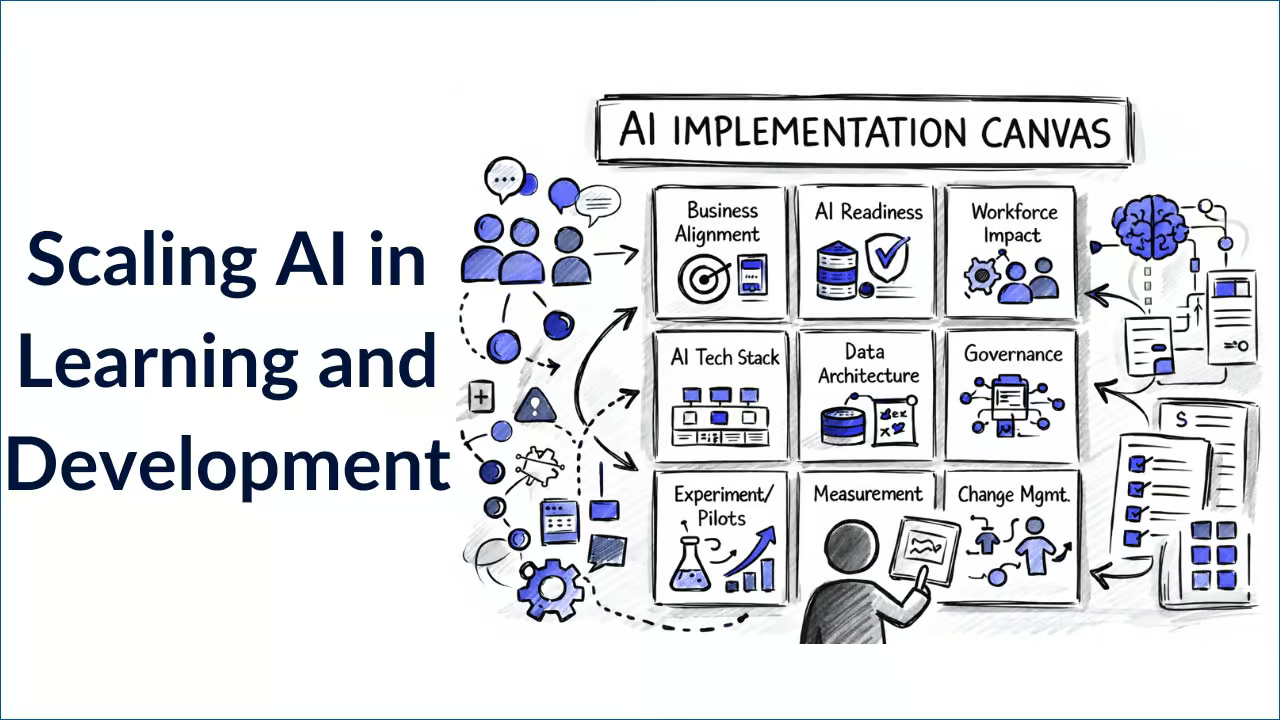
Summary: The AI Implementation Canvas helps learning organizations plan, govern, and scale AI initiatives by aligning IT, HR, and business leaders around a shared framework.
Moving Beyond AI Experiments
Many organizations have already started experimenting with artificial intelligence.
Learning teams are testing tools for:
- content development
- learner simulations
- knowledge assistants
- performance support
Yet experimentation alone does not create an organizational impact.
To scale AI successfully, organizations need a structured way to evaluate opportunities, align stakeholders, and measure outcomes.
One framework designed to support this work is the AI Implementation Canvas, introduced by learning strategy expert Megan Torrance.
The canvas provides a collaborative planning tool for organizations navigating AI adoption.
What Is the AI Implementation Canvas?
The AI Implementation Canvas is not a checklist or maturity model.
Instead, it is a conversation framework.
The canvas helps cross-functional teams explore the critical questions that shape AI implementation.
These questions span multiple dimensions of organizational change, and Megan covers them in detail in her new book, The AI Implementation Guide for L&D.
The goal of the AI Implementation Canvas is to help organizations move from isolated AI experiments to coordinated and successful enterprise-wide implementations.
Four Key Planning Areas
The canvas organizes AI planning into four major categories.
1. Strategic Foundations
Successful AI initiatives begin with strategic clarity.
Key questions include:
- What business problem(s) are we solving?
- What outcomes define success?
- Is the organization ready to adopt this solution?
Teams must also consider workforce impact.
AI often changes job roles, workflows, and skill requirements.
Addressing these questions early helps organizations avoid costly implementation mistakes.
2. Technology and Experience Infrastructure
AI systems depend on reliable technical foundations.
Organizations must consider:
- data architecture
- system integration
- model governance
- workflow integration
User experience is particularly important.
An AI tool that slows employees down will not be adopted.
Successful AI systems fit naturally into existing workflows.
3. Design and Implementation Enablers
Scaling AI requires structured experimentation.
Organizations should define:
- how pilots are conducted
- how results are evaluated
- how successful pilots scale into production
Measurement is critical.
Simply counting AI tool usage does not demonstrate value.
Organizations should track outcomes such as:
- performance improvement
- workflow efficiency
- decision quality
And what outcomes are analyzed needs to be driven by your Strategic Foundations.
4. Human-Centered Adoption
Technology adoption ultimately depends on people.
The canvas highlights the importance of:
- change management
- training and upskilling
- collaboration across teams
This includes developing three levels of AI capability.
- AI literacy helps employees understand basic concepts.
- AI proficiency enables individuals to apply tools effectively.
- AI fluency allows teams to innovate together using AI systems.
Ethical and Responsible AI
Another important dimension of the framework is responsible AI usage.
Organizations must address questions related to:
- bias and fairness
- transparency
- data security
- accountability
Responsible governance ensures AI initiatives support both business goals and ethical standards. If your organization already has approved AI policies, the plan needs to take these into account. In addition, use this process with your pilot to determine if changes need to be made to these policies, or if the pilot can inform the development of AI policies if they don’t exist.
Why This Framework Matters for L&D
Learning teams play an important role in AI implementation.
L&D professionals understand how people learn new workflows and adopt new tools.
They also have visibility across the organization.
This perspective allows them to help align AI initiatives with workforce capability development.
Learning teams can support AI initiatives by:
- facilitating cross-functional conversations
- designing learning programs for new workflows
- evaluating AI adoption outcomes
Learning platforms and content management systems also play a role.
For example, tools like dominKnow | ONE support structured content creation and reuse, helping organizations manage learning resources as AI-driven workflows evolve.
A Framework for Collaboration
The AI Implementation Canvas is most effective when used collaboratively.
The framework encourages organizations to bring together perspectives from:
- learning and development
- IT
- operations
- HR
- business leadership
By aligning these perspectives early, organizations can move beyond fragmented pilots and build scalable AI initiatives.
From Conversation to Action
Artificial intelligence presents enormous opportunities for learning organizations.
But technology alone will not drive transformation.
Successful AI adoption requires:
- strategic alignment
- strong governance
- workforce development
- cross-functional collaboration
Frameworks like the AI Implementation Canvas help organizations structure these conversations and move from experimentation to meaningful impact.
To learn more about having successful Pilot Programs review, Why Most AI Pilots in L&D Fail to Scale (And How to Fix It)