Introduction
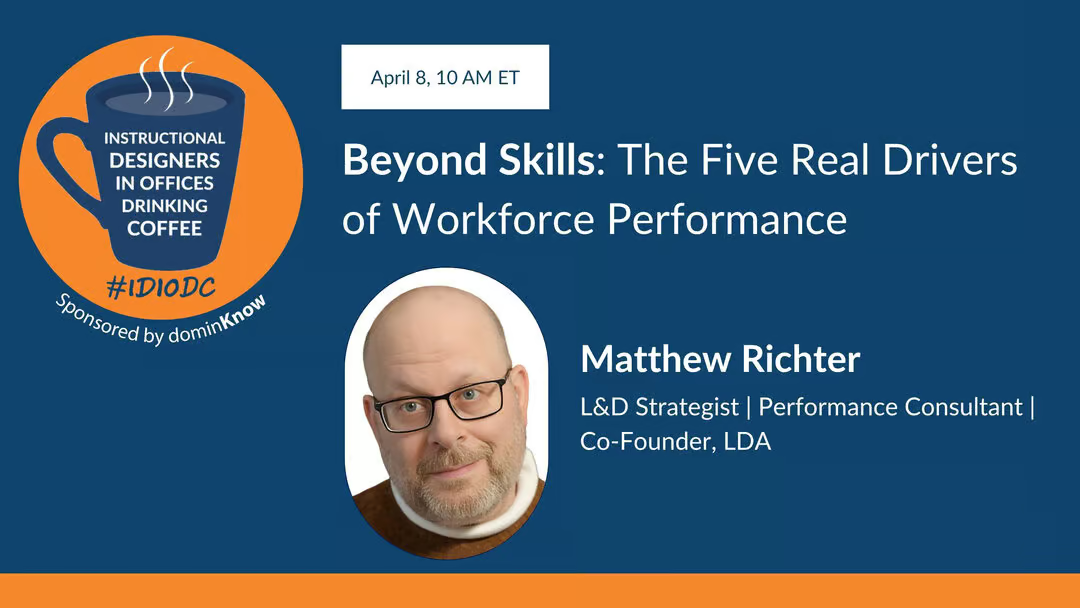
Chris Van Wingerden: Hey folks, we've got a really neat time together set up here today. My colleague Paul's away — sometimes people take vacations, which seems wrong, but it's a troubling trend. Every session of Instructional Designers in Offices Drinking Coffee is brought to you by dominKnow, the team that brings you dominKnow ONE, helping learning and development teams develop, scale and deliver learning that maximizes employee value. Check us out at dominKnow.com.
Chris Van Wingerden: We have a really special guest here with us today — Matt Richter from The Thiagi Group. Matt, you haven't actually been with us before here on IDIODC.
Matthew Richter: That is not accurate. I was with you years and years ago.
Chris Van Wingerden: Oh my gosh, I'm very sorry for that. Maybe some folks didn't catch that conversation. So introduce yourself to our crowd here today.
Matthew Richter: I'm Matt. I'm a trainer and I work with a guy named Thiagi. I'm also the co-director with Clark Quinn of the Learning Development Accelerator, which is a global professional community for L&D folks.
Chris Van Wingerden: We're talking today about the five real drivers of workplace and workforce performance. Tell us a little bit before we jump into the actual five — maybe some of the things that we're not talking about.
Overview: The Five Drivers of Workforce Performance
Matthew Richter: For a while now we've been talking a lot about skills in the workplace, and before that we talked about competencies, and before that about innate talents or aptitudes. Both aptitude and skills were fairly well embedded in the way we talked about what got us to some form of performance outcome.
Matthew Richter: But more and more there's research that shows there are other factors that strongly influence whether someone is successful — both in general in their life, but also day to day in how they go about doing things. One of those is access and privilege. Are you born in an environment where your parents had money, or you had access to top schools, good food that enabled you to be healthy, or access to people who would mentor you? There's also the parallel part of privilege — the funding and other channels available to you. Access and privilege is huge, and the research shows there's a quite significant impact.
Matthew Richter: Another one, which I love from David Spiegelhalter — a mathematician-economist in the UK — is around luck. Luck is big. Do I turn right? Do I turn left? You might meet your future boss. You might meet your future significant other. And then of course, world events: COVID was a world event, the war in Ukraine, what's going on in Iran right now. We can't control those things, but they have a huge impact on us. So the five all interplay together.
Chris Van Wingerden: Sticking with luck for a minute — it's absolutely just luck or coincidence that I even have this career. The first organization in this space was actually dominKnow, but I started working there because someone else couldn't work for them and said, "talk to Chris." That was entirely just luck. And now I've been doing it for 20-plus years.
Matthew Richter: It could have been, "Oh, Andy's the guy you should call." What if that friend had just said someone else's name? The world would be a different place — I wouldn't be here with you.
Chris Van Wingerden: Let's reiterate the five just so people can know what they're working with.
Matthew Richter: Aptitude, skill, luck, access and privilege, and big world events.
Aptitude
Matthew Richter: Aptitude is huge because there's a genetic or organismic component to how successful we are — a piece of how intelligent one is, whether you're born in a way where you're going to be tall or short. There's a genetic component to our capabilities, and that interplays with the environment as well. I may have a certain level of base intelligence, but if that doesn't get catered to and fostered, that level of aptitude doesn't come out.
Matthew Richter: The trick is that it's really hard to tell if something is skill or talent. John Medina, the neuroscientist, said it's always skill or talent — but who cares which is which, because we can't tell. Skill is the stuff we can practice that we get better at, but that practice requires good instructional design around it. We need what Ericsson called deliberate practice. If I have some talent and I have the structure to go through good learning and practice opportunities with feedback, then I do better.
Chris Van Wingerden: So aptitude — one of the things we're shaping around in our discussion here today is, what are the things where the L&D team can actually have an effect? It seems to me that aptitude really isn't something an L&D team can actually shape or contribute to.
Matthew Richter: Well, I think it is. We can partner with HR, talent management, or whatever it's called nowadays, and we can identify what people have an inclination to do and foster that. I'm not advocating for doing IQ tests in the workplace, but there are things that people like to do, and we can find ways to embrace that and help develop through skill building. We can also look at how we marry aptitude to access and privilege — are we inviting people to engage in that?
Matthew Richter: I would really urge our L&D teams to work in the communities. It all starts in good schools. What are we doing in our communities to provide access to people? How are we going out coaching and mentoring folks in the community? What are we doing as an L&D team in our communities to enhance those points of access and privilege?
Matthew Richter: Not much we can do about luck, but what we can do is, when someone is hit with bad luck, how do we help them recover from that? Keith Grant, a historian, talks about wicked, tame, and critical problems — COVID was a wicked problem. How do we navigate through that? L&D can certainly have a huge role in brainstorming and being part of coming up with solutions for these wicked problems. So L&D can touch on all of them.
Chris Van Wingerden: I guess when I thought about aptitude I was thinking — if someone's already in a job, I hadn't thought of the idea of helping people find the things that fit them. That pre-step. I was thinking from the frame of the L&D team creating content or training programs — more about roles versus maybe the pre-steps of getting people into the right roles.
Matthew Richter: I like that frame. Let's pull the string a little. Can we talk about what development really means? Development can mean: you're already on your trajectory, so we're going to develop you and provide opportunities for you to continue down that straight linear line. Or we could look at development as zigzagging all around. Are we finding ways to enhance overall wellbeing? Are we finding ways to get people excited about what they're working on? Are there ways for people to develop other areas that may become of interest in new directions later for them? What do we mean by development organizationally, and how does that enhance wellbeing and satisfaction in the workplace?
Skill Development
Matthew Richter: I like to play the guitar. One of the things I've had to do over the years is practice. I'm taught how to play guitar by a teacher — scales, how to read music, fingering position on the fretboard, how to engage with the strings, how to put things together. But that requires guided instruction with practice opportunities. And those practice opportunities require feedback. My teacher would give me feedback, and as I got better I started to play out with audiences. Whether they booed me or walked out, that was feedback — but it wasn't useful feedback unless someone told me: here's what you did wrong, here's what you can do to do things better.
Matthew Richter: So skills are developed through guided instruction, practice opportunities, and informational feedback — and then back again as you go through it. We need to develop skills, but you don't develop skills without some form of thoughtful instruction, practice, and feedback. Of course you probably need an interest in it, and you probably need some form of aptitude that goes with it. And then access, privilege, luck, and world events get in the way.
Access, Privilege, and Luck: Examples
Matthew Richter: World events — COVID is a good one. Luck might be: I'm on the train sitting next to a professor who is really interesting, and at the end of the train ride says, "Why don't you come to the campus and we'll talk about you going back to school and working on a graduate degree?" If you hadn't sat next to that person, you don't get that. Or luck might be you're on an airplane on September 11th, flying to Washington DC, and the plane is hijacked. That's bad luck.
Matthew Richter: Spiegelhalter — or I think it may have been Brian Kloss — writes about 9/11 and all the factors of luck that came into play on who lived and who died that day, just on "did I turn left or did I turn right?" Luck can show up in different ways. There's the luck of to whom you're born — the existential luck. Which country are you in? A country that's got a lot of money, schools available to everyone, better healthcare, better food. All of these things are pretty big around luck, access, and privilege.
Matthew Richter: Bill Gates is a wonderful case study of access and privilege. He worked hard. He had great ideas. He was certainly smart — but boy did he get lucky in life. He drew that winning lottery card. That's luck at different levels. Skill we talked about, and aptitude might be general intelligence, musical capability, and so on.
L&D's Role Across All Five Drivers
Chris Van Wingerden: Let's circle back and start thinking about the ways those of us in the L&D space can actually support or impact some of those things.
Matthew Richter: We have direct access over skill — that's the obvious one. But if we're not realizing that some people have been successful because luck played a role, we're not acknowledging reality. There is absolutely an interplay between all five of these factors. As L&D, we should be sitting down and saying: how do we make things more fair? How do we deal with equity? How do we make sure people coming into our company are getting a fair shake? And what about people who may not have experience or capability today, but certainly could tomorrow — is there some kind of program where we could work on developing them?
Matthew Richter: What is our big picture for creating a more equitable environment for our communities? How do we as L&D play a role in mitigating things when they go wrong? Failure is one of the most important ways in which we learn. Do we really embrace failure? And how much of failure has a luck component to it as well? Sometimes it's because we don't know what we're doing, but sometimes it's just because something bad happened — the power goes out at the worst time. We in L&D can play a leadership role in navigating how all five of these get addressed at a policy level. Maybe we're not the decision makers, but we could make a good case — or try at least.
Chris Van Wingerden: One of the themes we've always ended up circling back to throughout our entire time doing IDIODC is: how does the L&D team make a bigger difference by moving from being perceived as a service provider — here's five PowerPoints, make us a training course — to having a greater voice in the organization as a whole? How do we start taking some of these conversations outside the box?
Matthew Richter: Let's elevate our game. Let's stop being order takers. Let's stop doing junk. Let's stop doing MBTI, DISC, or Insights — tools that have been long debunked. Let's stop talking about learning styles. Let's stop doing content or interventions that have no impact. Let's actually do real evaluation. If you go with Will Thalheimer's LTA, at a level five or higher, let's measure whether people are actually learning — not just whether they're sitting in seats. Let's actually have an impact.
Standards and Professionalism in L&D
Matthew Richter: To have impact, we need to start talking about standards. ISPI, ATD, IBSTPI — everyone's got their version of some form of standards, but we're the only industry that doesn't have a common agreed-upon set of standards. Medicine has standards. You cannot become an accountant and work in finance without having met a core agreed-upon set of standards. But L&D wants to be a profession — we should have a core set of standards. Who should set those standards? That's not my problem to solve. But if we want to claim to be a profession, we should actually act like it.
Chris Van Wingerden: So many of us come into this space from side methods. We don't end high school or university saying, "this is where I want to go." We end up being tapped on the shoulder — "Oh, you know about this, can you run a workshop?" or "You're good with graphic design, why don't you help us make e-learning?" It really feels like we've got this traditional apprenticeship model where you learn from the people who are your bosses, and you do the things that people ahead of you in these roles have done. That may bring some good habits, but it also brings lots of poorer habits and misconceptions. Having a more formal identifier — standards you are meeting — helps break out from the inheritances we carry when we're pulled into L&D team roles.
Matthew Richter: I totally agree with that. We've all done it. I used to sell DISC through Thiagi, and I made more money selling DISC than we'd ever made on anything else. I didn't know any better back then. Part of that is because the DISC people we were dealing with told us that it was research-based, and I didn't know what research-based meant well enough. I thought I did, but that was good enough for me. So I think we need to increase our literacy around what good research looks like.
Research Literacy and Challenging Claims
Matthew Richter: We need to challenge when people say "research says…" — and I think that should become a core competency that every standardization process should include. Anyone who says "research says" should be immediately challenged: Show me the research. Was it replicated? How was it done? Were there conflicting agendas by the people who ran it? We should all have a base understanding of what statistics are and how to read them at a fundamental level. We don't need statistics for physicists — we can do statistics for L&D professionals. We need to get better at that, and we need to get better at what we put in front of our stakeholders and at challenging our stakeholders.
Chris Van Wingerden: Autumn noted in the chat: "I feel like people who have challenges which they do not feel comfortable disclosing could be creating barriers to their own success. If we provide space for openness, it provides room to create a more equitable development."
Matthew Richter: Yeah, I think that's probably true — people who don't necessarily have access and privilege opportunities don't want to acknowledge that because they're punished or put further behind. Acknowledging our vulnerabilities is really problematic. I totally agree, and I think that's something we can model as well as develop in management and leadership. When we see someone doesn't have access to something or is lacking a skill, our first response should be: how do we backfill that?
Chris Van Wingerden: And that can be hard in a really large organization where thousands — if not tens of thousands — of folks come into contact with us or with the programs we create. It's not an easy nut to crack.
Matthew Richter: No. But large organizations also have more resources. It's tough if it's a small company with few resources. It's tough if it's a big company with lots of resources. It's tough regardless. We've got to take a step back and say: what's our purpose? What's the meaning of life for us in L&D? If it's simply to infotain or to backfill skills for a database, then all we will ever be are order takers. But if our real purpose is to find ways through the course of work to develop people toward higher levels of actualization, then we're doing good stuff. Maybe we should re-narrativize the story we're telling about what a role is.
The "Chosen One" Problem and Succession Planning
Matthew Richter: I like David's comment about who's the next chosen one. The idea that someone is the chosen one is really bothersome on so many levels — but it's there. Usually when someone is earmarked as the chosen one, we stop developing others. That one person becomes the expected head of whatever — a functional role, a titled role, whatever — and we put a ton of resources behind that person and stop putting resources behind others. That's not a good way for us to be.
Matthew Richter: Succession planning doesn't necessarily mean we have identified a "chosen one." It might mean we have three or four people who could take on a functional role, and everyone can be taken care of and supported and advanced in ways that work for them.
Chris Van Wingerden: The chosen one is really a prime example of privilege — or it becomes an example of privilege that someone is being privileged above others because of that designation.
Matthew Richter: Exactly.
Chris Van Wingerden: Autumn's comment in chat: "There's a difference between checking the boxes of learning and development and striving towards the actualization that you spoke of, Matt." So much of what we do is about the CYA aspect — making sure folks are versed in security-related things to reduce risk, or other skills related to risk areas.
Problem Categorization: Wicked, Tame, and Critical Problems
Matthew Richter: I really like Keith Grain's typology around problems — he got it from Telen and Weber back in the late 1960s — around wicked, tame, and critical problems. If we try to categorize at an intake level what kind of problem we're being asked to help solve, it helps us target the right intervention.
Matthew Richter: A wicked problem might be looking at actualization opportunities or access and privilege opportunities to fix, or how to mitigate someone's failure due to bad luck. At the tame problem level, we can deal with: we have a tactical problem, we need to upskill someone because a new database is coming in. Or it's an emergency — like making sure everyone can figure out how to work from home during COVID — and that becomes a critical problem. L&D can categorize the types of problems we're dealing with, and that makes our work a little more universal and hopefully strategic.
The Six Boxes Model
Chris Van Wingerden: I've heard of the six boxes model but don't have much experience with it. Can you flex that up a bit?
Matthew Richter: Well, lots of people have a six-box model. Tom Gilbert had six boxes. Thiagi has six boxes. But the notion is: is it a motivation problem? Is it a structural problem? Is it a knowledge and skill problem? Is it attitudinal? And there are variations of those. As you go through them, you can identify what kind of problem you're dealing with and then target the intervention. It's only a training solution if it's a knowledge and skill gap. If it's a motivational gap, we have a different intervention we probably need. Attitudinal problems tend to go hand in hand with motivational ones, but that's a more social and cognitive psychology response versus the behaviorist version that Gilbert, Thiagi, and other "box" people come from.
Root Cause Analysis and Systemic Thinking
Chris Van Wingerden: What are some of the simplest steps that folks could do to just get started down this pathway?
Matthew Richter: Maybe do more root cause analysis. The trick is garbage in, garbage out. Sometimes it's an access and privilege problem, but because we're only looking for an aptitude or skill problem, that's all we find. We need to take a step back and try to determine where in the system luck is popping its head, where we have access and privilege issues.
Matthew Richter: What we're doing in the US around DEI is concerning. At a base level it's embarrassing, but at a systems level we're undermining our whole notion of equity for people — both in schools, the workplace, and in communities. So we need to depoliticize this and have conversations about the system. We should be facilitating conversations about the system and asking: where is this systemically an issue around aptitude? How is it interplaying with skill — because those two go hand in hand? As Medina said, we cannot always differentiate what's talent and what's skill. How is this an access component? How is this a luck component? How is the invasion of Iran affecting our company around prices — we're seeing this with the airlines? How do we help support and mediate some of the issues that arise around talent? We should be asking those systems questions.
Chris Van Wingerden: Those systems questions can be a source of friction. We've got to still get a paycheck, and we're not always privileged to be able to rock the boat successfully. It's a definite challenge for a lot of us in our space.
Matthew Richter: But isn't that our job? You don't see accountants working in finance worrying about, "I'm raising my hand because I see something wrong with the quarterly figures." For us, we've politicized some of these things, and that politicization becomes problematic if we're not able to call it out and say, "let's talk about it." It also happens culturally within the organization. Sometimes organizations don't feel safe. So we need to look at how do we foster psychological safety.
Psychological Safety and Candor
Matthew Richter: Psychological safety doesn't mean I'm anti-people speaking truth to power. Safety is not just about being nice. Safety is about being able to take risks in a way where you're okay doing so. Psychological safety is where people feel: I have an issue here, I can talk about it. It doesn't mean I have permission to attack you. I don't get to call you names, I don't get to be mean or cruel. I hate "radical candor" — I think it's just giving people permission to be cruel. But we do want candor. That's what Amy Edmondson talks about a lot in her work on psychological safety. Candor is important. Radical candor might be iffy.
Closing
Chris Van Wingerden: Matt, this has been a really cool conversation. We've gone lots of places that we don't always get to go here on IDIODC. I really appreciate your candor today, and your thoughts. Folks in the chat — thanks so much for dropping in and for the great conversation pieces we were able to weave in.
Chris Van Wingerden: One last reminder: this episode of Instructional Designers in Offices Drinking Coffee is brought to you by the team at dominKnow, makers of dominKnow ONE, helping L&D teams develop, scale and deliver learning that maximizes employee value. Matt, thank you so much for joining us.
Matthew Richter: It is a pleasure. Thank you, Chris.



.svg)

.svg)