


.svg)

.svg)


Implementing AI in L&D: Moving from Experimentation to Organizational Readiness


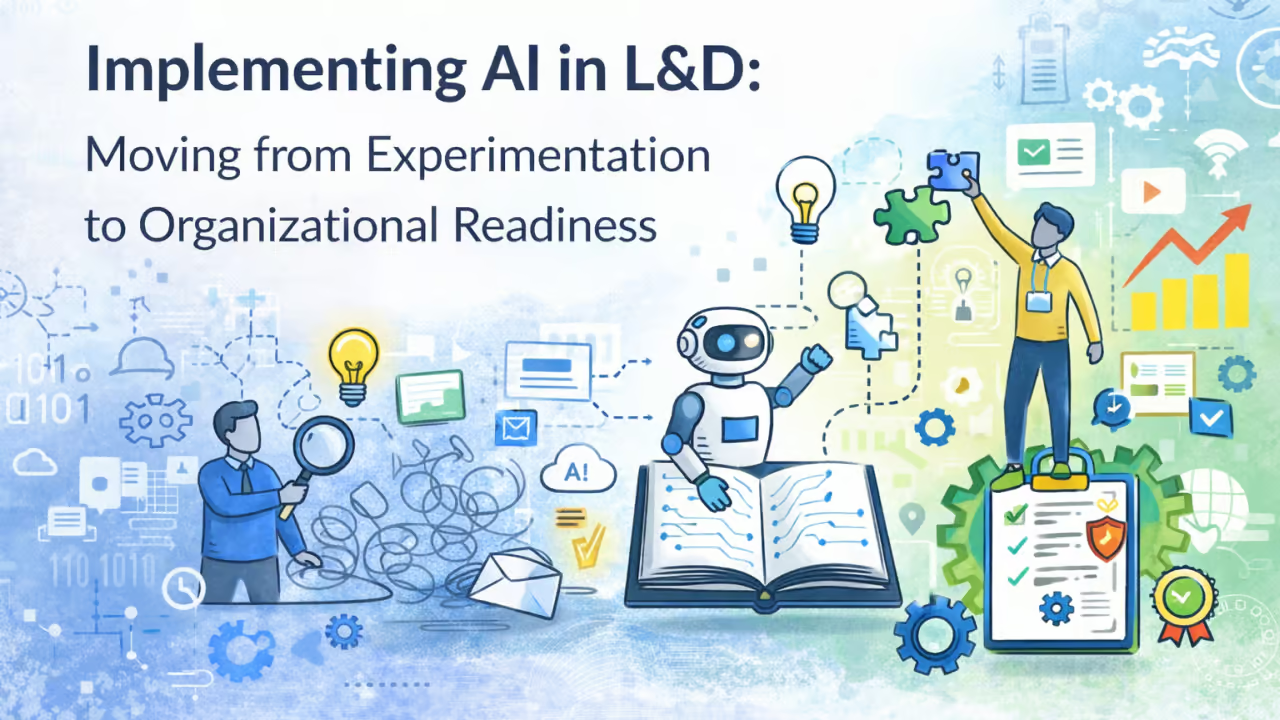
AI is no longer a fringe experiment in learning and development. It is showing up everywhere: embedded in productivity tools, content creation workflows, learning platforms, and increasingly inside the learning experiences themselves. Yet for many L&D teams, the excitement of experimentation has been replaced by a more sobering reality.
The hard part is no longer trying AI.
The hard part is implementing it responsibly, at scale, and in ways that actually support human performance.
That challenge was the focus of a recent episode of Instructional Designers in Offices Drinking Coffee featuring Megan Torrance, CEO of TorranceLearning and author of the upcoming book The AI Implementation Guide for L&D from ATD Press. Rather than offering tool-specific advice destined to become obsolete, Megan’s work tackles the deeper question facing L&D today: how do organizations make sense of AI together, and what do learning professionals have tooffer to that process?
AI Is Everywhere, but Direction Is Rare
In many organizations, AI adoption has followed a familiar pattern. Individual contributors experiment with tools on their own. Teams pilot isolated use cases. Leaders declare that “AI is a priority” without defining what success looks like.
The result is uneven progress. Some teams move quickly but take on unseen risk. Others hesitate, concerned about data protection, bias, or regulatory exposure. L&D often finds itself asked to enable AI use before the organization has aligned on guardrails, governance, or outcomes.
This is not unlike earlier moments when learning teams were asked to scale new delivery models quickly. What makes AI different is its speed and reach. Decisions made early can have lasting consequences, especially when AI becomes part of learner-facing experiences or performance support systems and it is critical to have a responsible AI enablement approach.
As Megan noted in the conversation, this moment feels less like a technology rollout and more like a collective sensemaking challenge.
Why Writing an “AI How-To” Book Would Fail
One of the most revealing moments in the discussion was Megan’s explanation of why The AI Implementation Guide for L&D is deliberately not a technical manual.
Her previous book on data and analytics went to press just as generative AI entered the mainstream. Almost overnight, the conversation shifted. Tool-specific guidance became outdated, not because it was wrong, but because the landscape had changed.
AI evolves too quickly for static instructions. What lasts longer are shared frameworks, planning questions, and decision-making structures.
This is not a book full of answers. It’s a book full of questions.
That distinction reframes implementation as an ongoing organizational learning process, rather than a one-time deployment.
AI Adoption Is an Organizational Learning Challenge
AI implementation is often treated as an IT or procurement issue. In practice, it behaves much more like a learning systems challenge.
AI reshapes workflows, job roles, and decision-making. It introduces new ethical considerations and changes in how people interact with information. These shifts cannot be managed through software alone.
This is where L&D has an opportunity to lead. Learning teams are accustomed to ambiguity, iteration, and behavior change over time. They design systems that help people adapt, not just comply with them.
As Megan pointed out, AI adoption mirrors earlier periods of rapid organizational change (remember the pandemic?). In those moments, L&D’s value was not in delivering content, but in helping organizations learn their way forward.
Why L&D Is Uniquely Positioned to Lead
L&D may not always have formal authority over AI strategy, but it often has something just as powerful: relationships.
Learning teams work across departments, supporting employees, leaders, and subject matter experts alike. That cross-functional visibility allows L&D to see where AI experimentation is already happening and where friction or risk is emerging.
Learning professionals also bring facilitation, systems thinking, and design sensibilities to the table. These skills are essential when AI initiatives require alignment across IT, legal, HR, and business units.
When supported by platforms that centralize learning content, governance, and updates, L&D can more effectively coordinate change at scale.
The Three AI Impact Zones: Clarifying Scope and Risk
A key organizing model in Megan’s book is the concept of three AI Impact Zones, which help teams understand where AI is operating and what level of responsibility is required.
- Zone 1: Personal Productivity and L&D Workflows
AI assists with drafting, summarizing, analyzing, and creating content. The outputs remain traditional learning assets, even if AI supports their creation.
- Zone 2: Learner Experience and Performance Enablement
AI is embedded directly in the learning experience, such as coaching bots, adaptive systems, or simulations. AI now interacts with learners, increasing the importance of accuracy, bias mitigation, and transparency.
- Zone 3: Work, Leadership, and Organizational Transformation
AI changes roles, workflows, workforce planning, and decision-making across the enterprise. L&D often responds by supporting reskilling and new ways of working.
Understanding which zone an initiative belongs to helps teams determine appropriate governance, planning depth, and risk tolerance.
Megan Torrance explains the three AI Impact Zones and why identifying where AI shows up is critical to responsible implementation and governance.
From Tools to Systems: The AI Implementation Canvas
Rather than prescribing a linear roadmap, Megan introduces the AI Implementation Canvas, a flexible planning and collaboration tool designed to organize the complexity of AI initiatives.
The Canvas brings together fourteen interdependent planning dimensions across four categories:
- Strategic foundations
- Technology and experience infrastructure
- Design and implementation enablers
- Human-centered adoption and change
Its value lies not in completion, but in conversation. Teams use the Canvas to surface assumptions, align expectations, and scale their level of rigor based on risk and impact.
This approach aligns well with how learning teams already manage complex, evolving programs across multiple audiences and delivery channels.
Readiness Is More Than Access to AI Tools
One of the most practical insights from the session was the reframing of “AI readiness.”
Readiness includes data quality, governance, workforce skills, and leadership alignment – not just AI literacy skillbuilding. Megan shared examples of safeguards such as audit trails, kill switches, fallback experiences, and monitored rollout environments, especially when AI is placed directly in learner-facing contexts.
Using governed, approved approaches, that align with overall business objectives are not barriers to progress; they are what make progress sustainable.
Literacy Is the Starting Line, Not the Finish Line
AI literacy helps people understand what AI is and what risks it poses. But literacy alone does not lead to effective use.
Megan distinguishes between literacy, proficiency, and fluency. Fluency emerges when teams can collaborate, experiment, and adapt together over time.
This is familiar territory for L&D. Designing continuous learning ecosystems, rather than one-time training events, is core to the profession. AI simply reinforces the need for that mindset.
Bias, Power, and Responsibility in AI-Enabled Learning
AI reflects the data and decisions behind it. Bias, exclusion, and harm are not abstract concerns; they are design outcomes.
Learning teams play a critical role in asking who is represented, who is excluded, and how AI-driven experiences may affect learners differently. At the same time, AI offers opportunities to expand access and personalization when used thoughtfully.
Balancing these realities requires intentional design and ongoing evaluation.
L&D as the Bridge Between Technology and People
AI implementation is not a single milestone. It is a continuous learning journey.
The AI Implementation Canvas is intentionally a living document, meant to evolve alongside organizational understanding. Its purpose is not control, but coherence.
As Megan emphasized, L&D professionals are uniquely positioned to help organizations move from reaction to intention, ensuring AI strengthens human performance rather than undermining it.
Continue the Conversation
Connect with Megan Torrance on LinkedIn
Pre-order The AI Implementation Guide for L&D
Subscribe and join Instructional Designers in Offices Drinking Coffee
Supported content management and distribution with delivery at scale