


.svg)

.svg)


Reflecting on 2025’s L&D challenges and dominKnow predictions


Following the predictions we made at the beginning of 2025, how many of them came true? In this post, we take a look back at what we expected to see last year, see how our predictions compare to what actually happened. From AI adoption to personalization to tightening L&D budgets, let’s review dominKnow’s 2025 expectations vs reality.
At the start of 2025, we identified 10 key challenges that we believed would shape the learning and development landscape throughout the year. From AI adoption for learning to hybrid workforce training, our aim was to help L&D teams anticipate where they’d need to focus their attention, and how to prepare for change.
Now that we’re heading into what’s set to be another fast-moving year in L&D, it’s the perfect moment to pause, reflect and ask: Which of our predictions came true? Which are still works in progress? And what does all of this mean for 2026?
Below, we will revisit each of the top 10 challenges we predicted for 2025 and explore how they played out in real organizations. Then, we will look ahead to 2026 for a first glimpse at what L&D teams should consider as they navigate the year ahead.
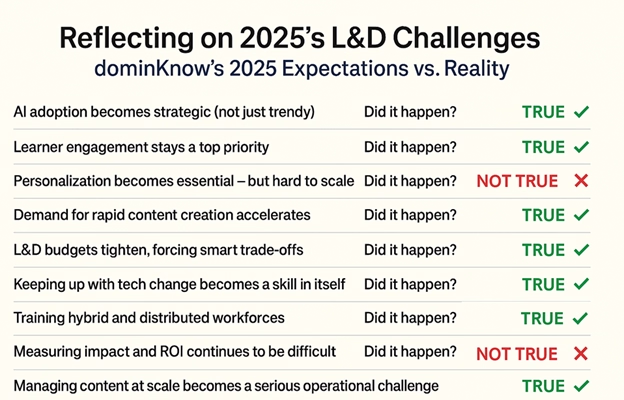
1. AI adoption becomes strategic (not just trendy)
The 2025 prediction
AI would continue its meteoric rise, but L&D teams would need a strategic approach rather than adopting tools simply because they were “cool.”
Did it happen?
Yes – but unevenly.
AI is now firmly embedded in L&D conversations. Many teams are experimenting with generative AI for content creation, translations, and performance support, while others are exploring AI tools for surfacing personalized learning content. But the key word here is experimenting – while the hype has grown, scaling effective, responsible AI use hasn’t always been straightforward. Some organizations are still stuck at the pilot stage, or are now navigating ethical and data privacy questions.
What to consider in 2026
Expect a shift from “testing AI” to governing AI. Generative AI tools often produce “hallucinations,” or made-up “facts,” which can be very wrong despite sounding very right. L&D teams will need clearer frameworks around accuracy (particularly around hallucinations and analyzing reliable data sources), data protection, responsible use, and integration with existing systems. If 2025 was about playing around with new AI tools, 2026 will be the year to move from experimentation to sustainable, well-managed deployment – but without using AI for the sake of AI.
2. Learner engagement stays a top priority
The 2025 prediction
Employee attention would be harder to capture as workloads grew and expectations for personalised, relevant content increased.
Did it happen?
Unsurprisingly, yes.
Busy employees continue to skim, skip, or postpone training that isn’t carefully crafted. Microlearning, performance support in the flow of work, and bite-sized content improved engagement, but many organizations still struggle with fragmented ecosystems and poor findability.
What to consider in 2026
To cut through the noise, learning needs to shift from content-heavy to context-heavy. That means organizations should prioritize personalized, purposeful content that is embedded in real tasks, taking it from purely theoretical to cemented in real-world activities. In 2026, high learner engagement will come from content that genuinely reduces friction in people’s workdays, and doesn’t require excessive time or effort.
3. Personalization becomes essential – but hard to scale
The 2025 prediction
L&D teams would prioritize accessibility, localization, and tailoring content for different roles, regions, and needs.
Did it happen?
To some extent.
The desire for personalized learning experiences is strong, but the operational reality is tough. Many teams lack the tools or processes to maintain multiple versions of the same content, leading to inconsistencies, excessive admin, and technical debt.
What to consider in 2026
Teams will increasingly turn to single-source content design to manage scalable personalization without multiplying effort. This shift won’t just improve efficiency – it will help maintain quality, accessibility, and multi-language consistency across the organization.
4. Demand for rapid content creation accelerates
The 2025 prediction
The pace of change would continue to push L&D teams to produce and update content faster than ever.
Did it happen?
Yes – and pressure is increasing.
Whether due to policy updates, regulatory shifts, or organizational change, L&D teams are still being asked to deliver high-quality content at speed. AI authoring tools have helped, but quality control and workflow bottlenecks remain common.
What to consider in 2026
Expect rapid creation to evolve into rapid iteration. Ongoing content updates – not big annual rebuilds – will become the new normal. It could be as small as updating a link, or replacing a single diagram. Workflow automation and better content governance will be essential – for instance, finding ways to avoid having to download and reupload multiple versions of a course every time a small update is required.
5. L&D budgets tighten, forcing smart trade-offs
The 2025 prediction
We predicted that L&D teams would need to do more with less by improving processes, consolidating tools, and designing more efficient workflows.
Did it happen?
Yes – very much so.
Economic pressure and organizational restructuring meant that many L&D teams operated with reduced budgets or headcount in 2025. Surprisingly, this pushed innovation: teams leaned into things like content reuse, templates, and process clarity more than ever before.
What to consider in 2026
2026 will reward teams who treat efficiency as a strategic capability. Look for opportunities to centralize content, consolidate technology, and streamline review cycles to maintain quality without sacrificing resources. Reusing and adapting existing learning content will also contribute to more time-efficient, cost-effective processes.
6. Keeping up with tech change becomes a skill in itself
The 2025 prediction
L&D would need to keep pace with the rapid evolution of technology across the business.
Did it happen?
100%.
From an explosion of new AI tools to evolving workplace platforms, L&D teams often found themselves learning the technology themselves before they could teach others. Skills frameworks and internal capability academies saw increased adoption, as well as a focused upskilling effort within the L&D team itself.
What to consider in 2026
Continuous upskilling will be essential – not just for learners, but for L&D professionals too. Expect more investment in learning ops, workflow learning, and skills-based content models. Cross-skilling will also be an important way to share expertise in specific new technologies, and L&D professionals shouldn’t neglect their own development when it comes to mastering the new tools used across the organization.
7. Training hybrid and distributed workforces
The 2025 prediction
As hybrid work solidified, the challenge would be providing equitable, high-quality learning experiences regardless of location.
Did it happen?
Yes – and the gap persists.
While there’s a steady return-to-office mandate in some sectors, 52% of US employees work under a hybrid model, with a further 26% working exclusively remotely. Many organizations improved their blended learning models, but consistency remains an issue, especially for compliance and role-specific training across regions.
What to consider in 2026
L&D teams should invest in centralized content ecosystems that deliver a single source of truth for training, regardless of format or location. That means that remote employees don’t get an inferior learning experience, but content can still be localized and translated for different languages and geographies. It’s also important to bring together eLearning, on-demand resources, instructor-led presentations, and student guides with variations on a single source for more efficient content publishing and delivery.
8. Measuring impact and ROI continues to be difficult
The 2025 prediction
L&D teams would feel growing pressure to demonstrate the business impact of training.
Did it happen?
Partially.
Interest in xAPI, dashboards, and data visualization grew, but true measurement maturity remains low. Many teams still rely heavily on completion rates, learning platform logins, and learner satisfaction scores – in other words, vanity metrics that don’t tell the full story about the real learning impact.
What to consider in 2026
We expect to see more L&D teams build internal data capability, including roles like learning data analysts, or upskilling focused on better learning analysis. Better integration between learning systems and business KPIs will become a priority, which will require the L&D team to work more closely with senior leaders across the business to ensure alignment of learning and wider organizational goals and metrics.
9. Managing content at scale becomes a serious operational challenge
The 2025 prediction
L&D would increasingly struggle with organizing, updating, and governing rapidly growing content libraries.
Did it happen?
Yes – and the challenge is only intensifying as organizations grow and become increasingly complex.
Outdated modules, duplicated assets, and inconsistent versions are still common – for instance, only the English language version of a course getting updated, while other language versions are neglected. Organizations with a centralized LCMS, such as Salience Learning, or single-source workflows fared dramatically better.
What to consider in 2026
We predict that 2026 will be the year of content governance. Clear ownership models, audit processes, and centralized templates will help learning teams stay in control, without having to scramble to stay on top of content updates.
10. Data privacy and security rise in importance
The 2025 prediction
As L&D tools collected more data – especially AI-driven tools – security and privacy would become a major concern.
Did it happen?
Yes – and faster than expected.
Many organizations introduced new procurement standards, AI policies, and data governance requirements that directly affect L&D tooling. This means that in some cases, procurement processes are taking longer, and involve more scrutiny from the IT department to ensure that data will be stored and processed safely.
What to consider in 2026
Expect increased scrutiny of AI vendors, data flows, and content storage. L&D teams should prepare to work more closely with IT, security, and compliance teams.
Goodbye 2025, hello 2026
Looking back, our 2025 predictions largely reflected the reality L&D teams experienced — though some challenges emerged more slowly, and others accelerated unexpectedly. What’s clear is that L&D continues to operate in a landscape marked by rapid change, high expectations (both learner and stakeholder), and increasing complexity.
To recap our key 2025 learning predictions (and how we think they’ll shift in 2026 – more on that very soon):
- AI adoption has increased, as we predicted, but we expect that 2026 will be about smart adoption of AI tools, rather than experimenting with everything.
- Scalability has become a bigger priority, and we expect this to continue into 2026 and beyond as organizations become more complex and globalized. This will require smarter processes to ensure consistent content creation and delivery.
- L&D are still struggling to measure the impact of their learning efforts beyond the standard vanity metrics. As a result, we expect to see more upskilling of learning teams in skills like data literacy, data analysis, and data storytelling in 2026.
- Over half the US workforce now works under a hybrid model. In 2026, this will require more focus on centralized content, ensuring consistency for employees who switch between remote and on-site working.
- As predicted, demand for rapid content creation has increased, but in 2026, the focus will need to switch to rapid, quality content creation through the smart use of authoring tools, rather than just generating courses quickly with AI.
As we enter 2026, the opportunity is not just to respond to these challenges, but to build sustainable learning ecosystems that allow teams to adapt, iterate, and deliver measurable business value for years to come. While AI will continue to play an important part in these ecosystems and processes, it will be crucial for learning teams to lean on the expertise of their human SMEs for thorough content review, elevated design, and smart, learner-centered delivery.
Look out for our 2026 L&D predictions post in the coming weeks for our take on what’s likely to be big this year…
Want to see how dominKnow | ONE can support your learning strategy in 2026? Get your demo here to make 2026 your most successful learning year yet.