


.svg)

.svg)


From Chaos to Clarity: Project Management Lessons for Instructional Designers



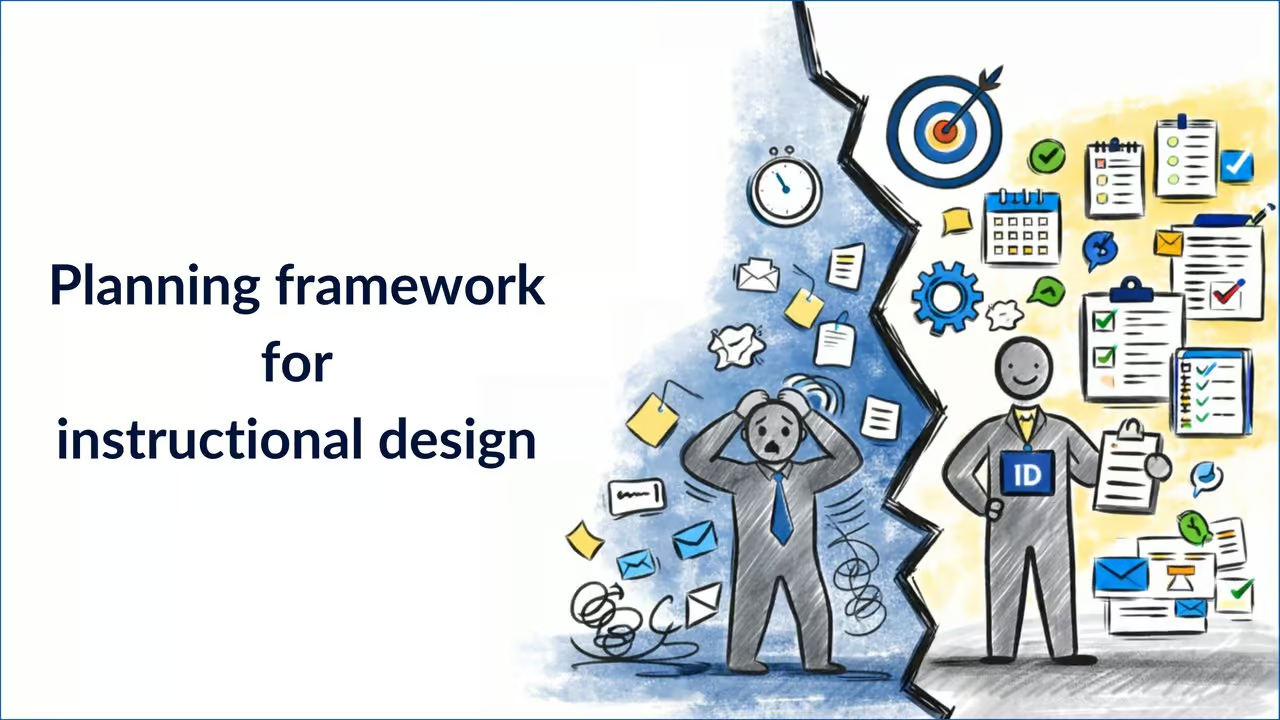
Instructional designers rarely enter the field expecting to become project managers. Yet somewhere between kickoff meetings, stakeholder reviews, shifting timelines, and last-minute changes, many instructional designers find themselves managing complex learning projects without ever being formally prepared to do so.
This reality was at the center of a recent episode of Instructional Designers in Offices Drinking Coffee, where we were joined by Guieswende Rouamba, PhD, instructional design scholar and author of The Instructional Designers’ Guide to Project Management. What emerged from the conversation was not a rigid framework or a checklist, but a practical truth many L&D professionals recognize immediately: effective project management in instructional design is as much about people and alignment as it is about schedules and deliverables.
For instructional designers feeling stretched thin, this conversation offers a clear path from chaos to clarity.
Why L&D Work Feels More Overwhelming Than Ever
Learning and development projects today are significantly more complex than they were even a few years ago. Instructional designers are expected to collaborate across teams, manage subject matter experts with limited availability, design for multiple delivery modalities, and support learning programs that evolve continuously over time.
What has changed just as dramatically are the expectations placed on instructional designers themselves. In the past, many learning initiatives included a dedicated project manager responsible for coordination, timelines, and stakeholder communication. Over time, that role has become less common across L&D teams.
Today, instructional designers are frequently expected to assume the project management role themselves, or to manage projects while simultaneously performing design and development work. This shift does not simply add responsibility; it introduces competing demands. Designers must think strategically, manage people and processes, communicate with stakeholders, and still deliver high-quality learning experiences.
When the feeling of being overwhelmed sets in, it is rarely due to a lack of skill. It is far more often the result of an expanded role without corresponding changes to structure, process, or support.
“I Had a PhD and Still Wasn’t Prepared”
One of the most striking moments in the conversation came when Guieswende reflected on his own academic journey. Despite earning both a master’s degree and a PhD in instructional design and technology, he had never taken a formal course in project management.
That realization ultimately led him to write The Instructional Designers’ Guide to Project Management, a practical resource shaped by experience rather than theory alone.
“I had a master’s and a PhD in instructional design, and I never took a single course on project management.”
Instructional design models provide strong guidance for analysis, design, development, and evaluation. What they often do not address is how work moves through organizations, how decisions are made, and how people experience the process behind the learning.
When Projects Struggle, Content Is Rarely the Root Cause
One story from the episode illustrated this clearly. Guieswende described a well-funded project with executive sponsorship, existing content, and modern learning technology. Despite these advantages, the project was ultimately shut down.
The issues were not related to instructional quality. Instead, there was no shared definition of success, no realistic capacity planning, and no alignment around the stakeholder’s vision for how learning would be delivered. What leadership envisioned as a live, interactive experience was designed as a self-paced online course.
Misalignments like this are common, even if they are not always as visible or consequential as a canceled initiative. More often, they surface as rework late in development, extended review cycles, missed expectations, or timelines that quietly slip.
These challenges are rarely solved by better storyboards or more polished media. What prevents them is clear planning, shared documentation, and early validation of expectations, before development momentum makes meaningful course correction difficult. Collaborative environments that support shared visibility, structured review processes, lifecycle management, and ongoing insight into project status can play an important role in reinforcing that alignment.
Project Management Is Really People Management
A central theme of the conversation was the idea that project management is fundamentally about working with people.
Guieswende explores this extensively in his book, drawing on Transactional Analysis, a framework developed by Eric Berne. The model describes three ego states that shape how individuals communicate and respond:
- Parent: directive, authoritative, rule-focused
- Child: reactive, emotional, resistant, or avoidant
- Adult: rational, reflective, and solution-oriented
These ego states appear regularly in learning projects. Stakeholders disengage when overwhelmed. Team members react defensively when expectations are unclear. Designers assert control when timelines feel threatened.
“It’s not project management. It’s people management.”
Recognizing these patterns helps instructional designers respond more intentionally, keep discussions productive, and maintain focus on shared goals.
The Planning Step Instructional Designers Often Skip
Instructional designers are trained to move quickly into design. Planning, by contrast, can feel slow or administrative. Yet planning is where many projects succeed or fail long before development begins.
Guieswende advocates expanding traditional ADDIE thinking by emphasizing a formal planning stage, often referred to as PADDIE. In practice, this means clearly defining eight foundational elements:
- Goal and vision
- Stakeholders
- Deliverables
- Acceptance criteria
- Exclusions
- Timeline
- Budget
- Constraints
Exclusions and constraints are especially critical and frequently overlooked. Explicitly stating what will not be done is just as important as defining what will.
Planning documents should not be static. They should evolve alongside the project, serving as living references that capture decisions and guide future work. When these materials are stored centrally with the learning project itself, teams gain continuity, clarity, and accountability over time.
Reducing Burnout Through Better Process Design
Burnout among instructional designers is often attributed to workload alone. In reality, it is frequently the result of unclear scope, unrealistic expectations, and unmanaged dependencies.
Good project management practices reduce burnout by making work visible, aligning expectations early, and creating space for honest conversations about capacity and constraints. Regular check-ins, even brief ones, help surface issues before they become crises.
“If we don’t have good processes, it can lead to burnout.”
Sustainable instructional design work depends as much on how projects are managed as on what is ultimately produced.
AI Changes the Speed, Not the Responsibility
Artificial intelligence is increasingly being used to support project management tasks, from drafting planning documents to summarizing meetings and estimating timelines.
These tools can accelerate work significantly, but they also amplify existing conditions. Clear goals and governed, approved source materials lead to faster alignment. Vague objectives and conflicting assumptions lead to faster confusion.
“AI amplifies the good and the bad. If your process is unclear, it will speed up the chaos.”
AI can support instructional designers, but it does not replace critical thinking, human judgment, or accountability.
Closing Projects Well Is Part of the Work
How a project ends matters. Effective closeout includes reflection, documentation, and recognition of effort, not blame.
Well-run retrospectives focus on learning: what worked, what did not, and what should change next time. Properly closing and organizing project assets also ensures future updates are easier and less disruptive.
When projects close well, teams are better positioned for long-term success.
Bring Your Heart
As the conversation concluded, Guieswende offered a simple but powerful reminder:
“If you say yes to a project, bring your heart.”
Structure, tools, and frameworks matter. So do empathy, honesty, and connection. Instructional design is human work, created by people for people. When projects are approached with both clarity and care, they become more sustainable, more effective, and more rewarding.
Continue the Conversation
- Connect with Guieswende Rouamba on LinkedIn
- Explore his book: The Instructional Designers’ Guide to Project Management
- Subscribe and join Instructional Designers in Offices Drinking Coffee